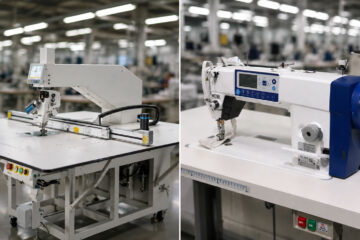
Fabric Inspection in Garment Manufacturing: Methods, Standards and Machines
09/11/2026
Fabric inspection is the inward quality check of every fabric roll before it is released to the cutting room: inspectors look for weaving, knitting and dyeing faults, measure actual width and length, and check shade consistency. The result decides whether a roll is accepted, rejected back to the mill, or used with conditions (fault avoidance, shade segregation). It is the first quality gate in the garment production process and part of the pre-production (PPA) stage.
Key points
- What is checked: visual faults, cuttable width, roll length, shade (roll-to-roll, side-centre-side, head-to-tail), and buyer-specified tests such as shrinkage or skewing.
- How: manual inspection tables, fabric inspection machines (illuminated frame + length counter), or camera-based AI inspection systems.
- Grading standard: the 4-point system (ASTM D5430) is the most widely used; acceptance limits are set by the buyer.
- Why it matters: a fault caught on the roll costs far less than one found after cutting, sewing or at final AQL.
What is fabric inspection and where does it sit in the RMG workflow?
Fabric inspection happens in the fabric store right after goods receipt and before relaxing, spreading and cutting. In most RMG units it is run by the fabric QC team under the material warehouse.
Typical flow:
- Fabric receipt → check against the mill’s packing list (rolls, colour, dye lot).
- Fabric inspection — faults, width, length, shade.
- Roll disposition: OK / reject / conditional use; shade grouping.
- Relaxing for knits and stretch fabrics.
- Spreading and cutting — see the cutting room procedure.
Inspection feeds directly into the factory’s quality management process: without inward control, inline and final inspections only catch fabric problems after money has been spent on them.
Why is fabric inspected before cutting?
Because a fabric fault cannot be repaired once panels are cut — a missed fault can spoil a whole lay of multi-ply panels or create shaded garments that the buyer rejects. Inspection lets the factory:
- Protect cutting output — fault positions are known before spreading, so they can be cut out or avoided.
- Raise supplier claims — roll-wise point reports are the evidence for replacement fabric or price discounts.
- Control shading — shade variation between and within rolls is detected and rolls are grouped before cutting.
- Plan consumption correctly — actual cuttable width and length often differ from the roll ticket; markers need real width.
- Pass buyer audits — many brands require documented fabric inspection records against their own manual.
What is checked during fabric inspection?
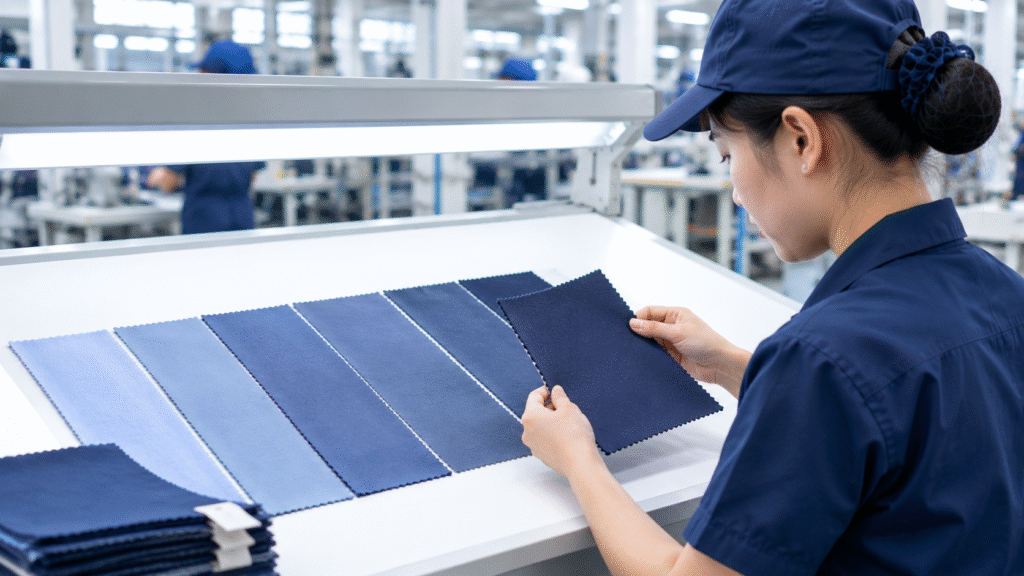
A complete inspection covers five areas: visual defects, width, length, shade, and any buyer-specified tests.
| Area | What is checked | Common method |
|---|---|---|
| Visual defects | Yarn, weaving/knitting, dyeing/printing faults, holes, stains | Roll runs over an illuminated inspection frame; faults are marked and scored |
| Width | Cuttable width vs. order requirement | Measured at several points along the roll |
| Length | Actual length vs. roll ticket | Length counter / measuring wheel on the machine |
| Shade | Roll-to-roll, side-centre-side, head-to-tail variation | Against master swatch / shade band in a light box, or colour sensors |
| Buyer tests | Shrinkage, bowing/skewing, hand-feel | Per buyer manual, usually on a sample cut from the roll |
Common fabric defects found during inspection
- Yarn faults: slubs, thick/thin places, contamination.
- Weaving / knitting faults: broken ends and picks, missing yarn, barre (knits), needle lines.
- Dyeing / printing faults: patchy dyeing, streaks, misprints, spots.
- Physical damage: holes, cuts, oil stains, dirt, permanent creases.
- Geometry: bowing, skewing, uneven width, curling selvedge.
Defect names vary between mills and buyers — agree a defect list upfront. See our garment industry terminology glossary.
Fabric grading systems: 4-point, 10-point and buyer standards
The 4-point system, standardised as ASTM D5430, is the most common grading method in apparel; some mills still use the 10-point system, and most brands publish their own acceptance limits.
4-point system at a glance
Each fault is penalised 1 to 4 points by length; no single fault gets more than 4 points.
| Fault length (warp or weft direction) | Penalty points |
|---|---|
| Up to 3 in | 1 |
| Over 3 in up to 6 in | 2 |
| Over 6 in up to 9 in | 3 |
| Over 9 in | 4 |
| Hole / opening ≤ 1 in | 2 |
| Hole / opening > 1 in | 4 |
Roll points are normalised to points per 100 square yards:
Points/100 yd² = (Total points × 36 × 100) ÷ (Cuttable width in inches × Yards inspected)
There is no universal pass mark. 40 points/100 yd² per roll is often quoted, but buyers set their own limits by fabric type, usually with both a per-roll limit and a lot-average limit. A step-by-step calculation guide is covered in our dedicated 4-point article (link to be added once satellite #2 is published).
Quick comparison
| 4-point system | 10-point system | Buyer manual | |
|---|---|---|---|
| Usage | Most common in RMG | Less common; some woven mills | Brand-specific |
| Scoring | 1–4 points by fault length | Heavier penalty scale by fault length | Usually 4-point with own limits |
| Normalisation | Points/100 yd² | Total points vs. total yardage | As per manual |
| Strength | Simple, easy to train, widely accepted | Penalises long faults more | Matches customer expectations |
The 10-point penalty table is not reproduced here because it could not be verified against a primary source in this run — add from an approved reference if needed.
Fabric inspection procedure in a garment factory (6 steps)
A standard procedure runs: receipt and sampling → set-up → roll inspection → scoring and marking → disposition and shade grouping → reporting and supplier follow-up.
- Receipt and sampling: reconcile rolls with the packing list. Select the number of rolls to inspect as required by the buyer or internal policy; raise the sampling level for new or poorly performing suppliers.
- Set-up: check lighting, length counter and machine speed; keep the approved master swatch and the grading standard at the station.
- Inspect each roll: run the fabric over the frame at a speed the inspector (or camera) can follow; measure width at several points.
- Score and mark: record each fault with its yardage position and flag it at the selvedge so the cutting room can avoid it.
- Disposition and shade grouping: OK / reject / conditional use; group rolls of the same shade into lots for cutting.
- Report and follow up: roll-wise, lot-wise and supplier-wise reports; raise claims where limits are exceeded; update supplier ratings.
Knits and fabrics with spandex/Lycra should then be relaxed before spreading so they shrink back to a stable state rather than after cutting.
Types of fabric inspection machines

A fabric inspection machine unrolls and re-rolls fabric over a lit inspection frame with a length counter, so faults are found faster and more consistently than on a table; newer systems add industrial cameras and AI to detect, log and mark faults automatically.
| Type | How it works | Best for | Limitations |
|---|---|---|---|
| Manual table inspection | Fabric laid on a lit table, checked by eye | Small units, sampling, low volume | Slow; depends on inspector skill and fatigue; poor data |
| Basic inspection frame | Roll-to-roll over lit frame with length counter; inspector finds and records faults | Most RMG factories | Results still inspector-dependent; manual reporting |
| Inspection frame + software / retrofit kit | Adds width/length measurement and software for fault entry, reports, supplier grading, ERP link | Factories that need data for claims and vendor rating | Detection still human |
| Camera + AI inspection system | Industrial cameras scan the fabric, software detects and classifies faults in real time and builds a defect map | High-volume factories needing consistency and traceability | Higher investment; supported fabric types vary by system — trial on your own fabric |
When an upgrade makes sense: inspection is a bottleneck before cutting; results differ between inspectors or shifts; buyers require roll-wise digital records; you need data for supplier claims. When it may not: small volumes, mostly mill-certified fabric, low fault history — a basic frame plus a disciplined 4-point procedure is often enough.
How does AI fabric inspection work?
AI inspection uses industrial cameras to image the moving fabric continuously; machine-vision software compares it with “good” fabric, flags anomalies, classifies them and records their position on a roll map. The operator’s job shifts from searching for faults to confirming and dispositioning them.
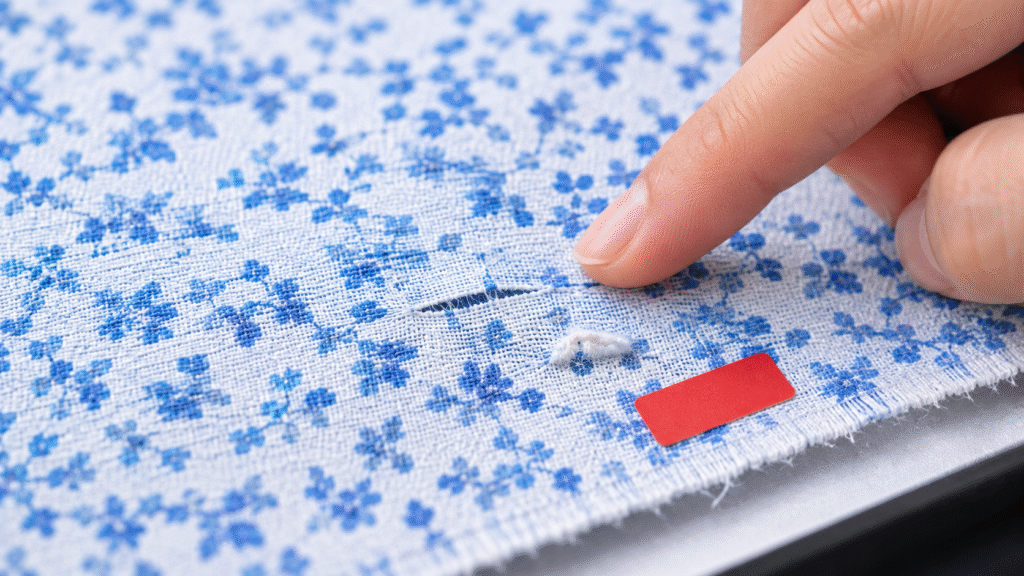
Typical functions: real-time detection with fault images · selvedge marking without stopping · roll-wise defect map and reports · ERP/MES integration · in some systems, an optimised cut plan for the roll.
Be realistic: accuracy depends on fabric construction (solid, printed, striped), colour, lustre and training data. Insist on a trial with your own fabrics before investing.
Shade inspection and relaxing: two linked pre-cutting steps
Shade inspection groups rolls by tone so that garments are not shaded; relaxing lets tension-sensitive fabrics settle before spreading.
- Shade inspection: compare each roll with the master swatch under standard illuminants, or measure colour along the roll with sensors and calculate Delta E (e.g. CIE2000, CMC). Output: shade band and shade lots.
- Relaxing: essential for knits and elastomeric/Lycra fabrics; the roll tension from winding is released so the fabric shrinks naturally. Method and time depend on the fabric and buyer requirements.
Reference solutions from Hoshima
Hoshima and its South Asia partner offer several fabric inspection and pre-cutting solutions; they are listed here as reference options to compare, not as a required part of the process.
| Solution | What the product page states | Fits when | Watch-outs |
|---|---|---|---|
| Q-Master AI fabric inspection machine | Industrial camera + analysis software; 40 m/min; standard 240 cm width; accuracy to 0.4 mm; non-stop edge labelling; defect mapping, custom reports, Open API to ERP/MES; standalone or added to an existing inspection machine | High volumes of plain, single-colour fabric (light, medium, dark) | Published scope is plain single-colour fabric — prints, stripes and checks need confirmation and a trial |
| Shelton Vision system (UK) | Multi-angle high-speed cameras and lighting; real-time defect map with image, type and position; optimised roll cut plan | Factories wanting fault detection plus better fabric yield | Speed, width and fabric scope not published — request catalog data |
| C-tex fabric inspection retrofit (UK) | Retrofit kit for existing frames: length/width measurement, quality reports, supplier claims and grading, ERP/SAP link | Factories that already have frames and need data, not new machines | Detection remains manual |
| C-Tex colour inspection | 3 sensors (left/centre/right) retrofitted to roll-to-roll machines; Delta E (CIE2000, CMC2:1, CMC1:1); roll maps, Excel/ERP output | Shade segregation without manual swatching | Results vary with the Delta E equation chosen |
| C-Tex relax machine | Roll-to-roll relaxing (lazy-loop + air floatation); 0–60 m/min; 2500 mm fabric width | Elastomeric / Lycra fabrics before automatic spreading | Not needed for stable wovens |
FAQ
It is the inward check of each fabric roll for faults, width, length and shade before cutting, so the factory can accept, reject or conditionally use the roll.
Because faults cannot be fixed after cutting. Inspection lets the cutting room avoid faults, enables shade grouping, corrects consumption planning and gives evidence for supplier claims.
Most RMG factories use the 4-point system (ASTM D5430): each fault scores 1–4 points and the total is converted to points per 100 square yards. Acceptance limits come from the buyer.
There is no single figure. 40 points/100 yd² per roll is often quoted, but many buyers set tighter limits by fabric type. Always follow the buyer manual.
It runs the roll over an illuminated frame with a length counter so faults are seen and logged consistently. Camera-based AI systems additionally detect, mark and record faults automatically.
Not entirely. AI reduces dependence on the human eye and creates data, but operators still confirm faults and handle exceptions, and performance depends on fabric type — run a trial first.
Contact us in Southeast Asia - South Asia:
- Singapore: 7 Temasek Boulevard, #43-01A Suntec Tower One, Singapore 038987.
- Vietnam - Philippines - Thailand - Cambodia: Unit 1, 3rd Floor, Building H, Street 17, Tan Thuan Export & Processing Zone, Tan Thuan Ward, HCMC, Vietnam.
- India: Sy. No. 23/8, Ground Floor, Masthappa Layout, Near Yashas Vidya Kendra School, Somashettyhalli, Chikkabanavara Post, Bangalore - 560090 , Karnataka, India.
- Bangladesh: Mizan House, 6th Floor, Flat 6/A, House 6, Road 2, Lane 1, Block G, Halishahar H/E, Chattogram, Bangladesh.
- Phone: (+84) 0983 309 910 (WhatsApp, WeChat, Zalo)
- Email: marketing@hoshima-int.com
- LinkedIn | Facebook | YouTube: Hoshima International