What Is an Industrial Sewing Machine? Types, Applications & How to Choose the Right One for Your Factory (2026)
28/07/2026
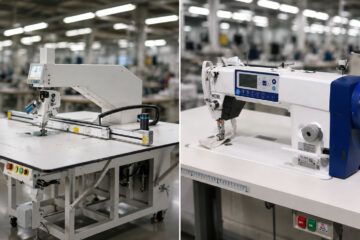
An industrial sewing machine is a sewing machine engineered for continuous, high-intensity operation in a manufacturing environment — unlike a domestic sewing machine, which is built for occasional personal use and cannot handle 8–12 hours of daily operation. Industrial sewing machines feature a more powerful motor and a sturdier frame, optimized for speed and durability at production scale.
Types of Industrial Sewing Machines
Industrial sewing machines can be classified in several ways. Below are the four most common classification approaches used in the industry:
1. By Operating Mechanism
| Type | Characteristics |
|---|---|
| Mechanical machine | Fully mechanical operation; auxiliary actions (thread trimming, presser foot lifting) are manual. Lower cost, easy to repair. |
| Electronic machine | Direct-drive motor, control board, automatic thread trimming. More energy-efficient, quieter operation. |
| Programmable machine | PLC/microprocessor controller with pre-set stitch and speed parameters. Consistent seams; the required foundation for building a Special Purpose Machine (SPM). |
📖 Learn more: “Mechanical vs. Electronic Industrial Sewing Machine: Pros, Cons & Which One to Invest In” and “What Is a Programmable Sewing Machine? Should You Upgrade From Mechanical Machines?”
2. By Needle Count
| Type | Application |
|---|---|
| Single-needle machine | Basic seams, body assembly — versatile, used across most operations. |
| Double-needle machine | Two parallel stitch lines, used for belt loops, pocket edges, double-stitch seams on denim/jackets. |
📖 Learn more: “1-Needle vs 2-Needle Industrial Sewing Machine: Which One Should Your Export Garment Factory Choose?”
3. By Stitch Type
- Lockstitch machine: the most common type, used for most basic assembly seams.
- Overlock machine: trims and finishes fabric edges, preventing fraying — typically used at the edge-finishing stage.
- Kansai (multi-needle) machine: used for binding seams, neckline/hem bands on T-shirts and knitwear.
- Bartacking and buttonholing machines: specialized for reinforcement points (pockets, zipper ends) and buttonhole creation.
4. By Level of Specialization
- General-purpose machine: handles a wide range of seam types, highly flexible.
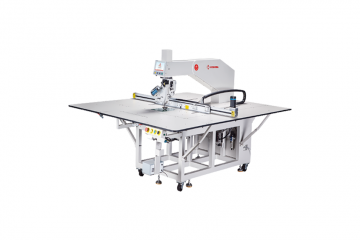
- Special Purpose Machine (SPM): a programmable machine fitted with a semi-automated jig/fixture/template system, dedicated to exactly one fixed operation (zipper attaching, glue bonding, logo pressing, etc.), delivering significantly higher productivity than a general-purpose machine for that specific task.
📖 Learn more: “What Is a Special Purpose Machine (SPM)? How It Differs From Standard Industrial Sewing Machines”
Applications by Garment Type
| Product type | Typical machine used |
|---|---|
| Basic T-shirts, underwear | Single-needle machine, overlock machine |
| Denim, jackets, workwear | Single-needle, double-needle, kansai machines |
| High-stretch/seamless sportswear | Special Purpose Machine (glue bonding replacing stitching) |
| Products with heat-transfer logos/labels | Dedicated automatic heat transfer machine |
| Products with long zippers (jackets, hoodies) | Zipper pre-expansion machine (pre-treatment before sewing) |
How to Choose the Right Industrial Sewing Machine for Your Factory
Machine selection should follow this priority order:
- Your factory’s core product type:
identify the operations that make up the largest share of production, and invest in the right machine type for those first.
- Volume and repetition frequency of each operation:
high-volume, repetitive operations should be prioritized for Special Purpose Machine (SPM) investment to maximize productivity.
- Investment budget:
balance mechanical machines (lower cost) against electronic/programmable machines (higher cost, but better output and consistency).
- Buyer/brand quality requirements:
export orders for major international brands typically carry stricter technical standards, which affects which machine type is needed.
- Local maintenance and technical support availability:
prioritize suppliers with after-sales service and spare parts readily available in your country.
What to Check Before Buying an Industrial Sewing Machine
- Prioritize suppliers with a branch or representative office in India or Bangladesh to ensure fast technical support when issues arise.
- Clarify the warranty policy and spare parts availability timeline.
- For SPM/specialized machines, request the supplier’s actual performance data (before/after processing time, productivity increase) rather than relying solely on marketing figures.
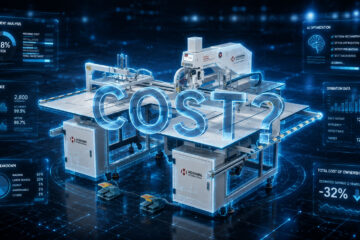
- Factor in the Total Cost of Ownership (TCO), including power consumption, maintenance, and operator training — not just the upfront purchase price. See also: “Industrial Sewing Machine Investment Cost for Small & Mid-Sized Garment Factories (2026)”
Frequently Asked Questions
Industrial sewing machines have more powerful motors and sturdier frames, built for continuous 8–12 hour daily operation at high intensity, while domestic sewing machines are only suited to occasional, low-intensity use.
Prioritize single-needle machines (mechanical or electronic, depending on budget) as the foundation, since they cover the widest range of operations. More specialized machines (double-needle, SPM) should be added later in proportion to actual order requirements.
Used machines can lower upfront investment cost, but factories should weigh the risk of reduced durability, higher maintenance costs, and difficulty sourcing spare parts for older or unbranded machine models.
Contact us in Southeast Asia - South Asia:
- Singapore: 7 Temasek Boulevard, #43-01A Suntec Tower One, Singapore 038987.
- Vietnam - Philippines - Thailand - Cambodia: Unit 1, 3rd Floor, Building H, Street 17, Tan Thuan Export & Processing Zone, Tan Thuan Ward, HCMC, Vietnam.
- India: Sy. No. 23/8, Ground Floor, Masthappa Layout, Near Yashas Vidya Kendra School, Somashettyhalli, Chikkabanavara Post, Bangalore - 560090 , Karnataka, India.
- Bangladesh: Mizan House, 6th Floor, Flat 6/A, House 6, Road 2, Lane 1, Block G, Halishahar H/E, Chattogram, Bangladesh.
- Phone: (+84) 0983 309 910 (WhatsApp, WeChat, Zalo)
- Email: marketing@hoshima-int.com
- LinkedIn | Facebook | YouTube: Hoshima International