Round Knife Fabric Cutting Machine: What Is It, and What Are the Applications and Limitations?
26/08/2026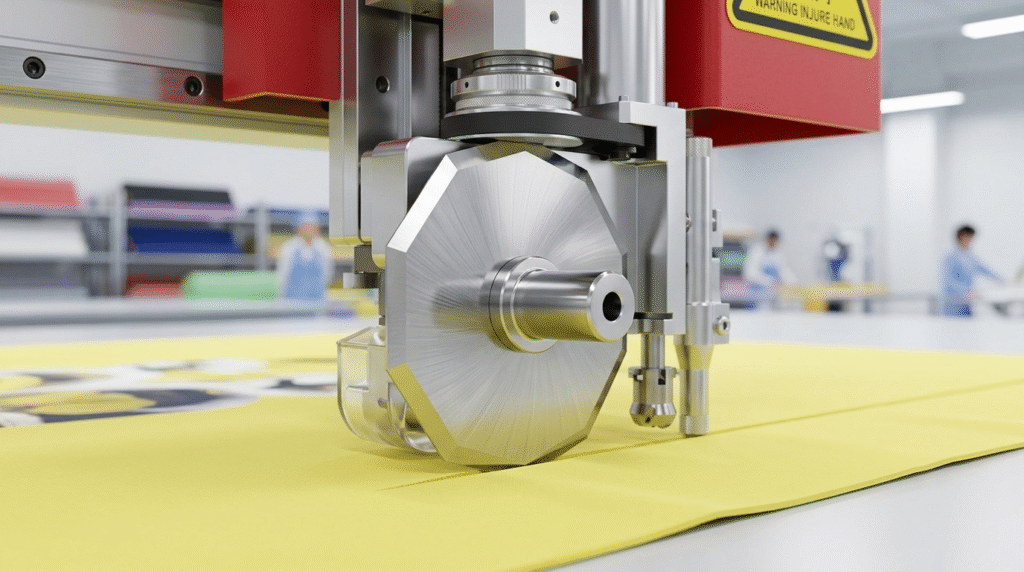
A round knife fabric cutting machine uses a disc-shaped blade that rotates continuously as it moves along the defined cutting path — different from a straight (oscillating) knife, which moves vertically up and down. Round knife technology is particularly well-suited to inconsistent materials or components requiring intricate, precise curved cutting lines.
How a Round Knife Works
The round blade is mounted on the cutting head, spinning continuously around its own axis throughout the cutting process. As the cutting head moves along the path (per a CAD design file or AI scan data), the rotating blade generates continuous cutting force, allowing it to smoothly handle curves, sharp corners, or complex shapes that a straight knife struggles to achieve with the same precision.
Advantages of a Round Knife Cutting Machine
- Handles inconsistent materials well: tanned leather varies in thickness and elasticity across different points on the same hide — a round knife adapts to these variations better than a straight knife.
- Cuts smooth, complex curves: well suited to components with multiple continuous curves and rounded corners — commonly found in footwear and bag components.
- High precision on individual pieces: particularly when combined with AI scanning technology, a round knife can follow the actual outline of the material rather than only cutting to fixed coordinates.
Limitations of a Round Knife Cutting Machine
- Not suited to cutting multiple layers at once: unlike a straight knife, which can cut through dozens to hundreds of stacked fabric layers, a round knife is primarily used for single-ply cutting or a very limited number of layers (typically 3–5 layers for thin fabric).
- Lower overall throughput for bulk production: due to the layer-cutting limit per pass, a round knife isn’t as efficient as a straight knife on a multi-ply cutting machine when high volume is needed.
Quick Comparison: Round Knife vs. Straight Knife
| Criteria | Round knife | Straight knife |
|---|---|---|
| Optimal layer count | Single-ply, or very few layers (3–5 for thin fabric) | Multi-ply (dozens to hundreds) |
| Smoothness on curves | Very smooth, precise | Good, but not as precise as round knife on complex curves |
| Best-suited material | Leather, footwear leather, PU leather, inconsistent materials | Woven fabric stacked in multiple layers |
| Best-suited production scale | Small orders, samples | Bulk, large orders |
Real-World Applications of Round Knife Cutting Machines
- Cutting tanned leather, footwear leather, PU leather: where each hide has its own size, grain, and imperfections, making it unsuitable for stacking multiple layers the way woven fabric is cut.
- Cutting fabric with a limited number of layers (3–5) requiring high precision: suited to small orders or sample development in apparel manufacturing.
- Combined with AI vision scanning + projection technology: when matching plaid or striped patterns across pieces is required — a round knife paired with an AI camera can cut precisely along the actual pattern outline on each fabric sheet, rather than only cutting to fixed coordinates.
Real-World Example: TOBU Single-Ply Cutting Machine
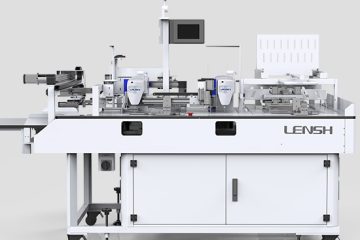
A leading example applying round knife technology combined with AI matching is TOBU — Hoshima’s single-ply fabric cutting machine, purpose-built for apparel manufacturing, small orders, sample development, and styles requiring precise plaid/striped pattern matching across components. The machine integrates a high-resolution AI vision camera and a system that projects the cutting layout directly onto the fabric surface, directly solving the biggest limitation of traditional cutting methods when handling repeating-pattern fabric.
Frequently Asked Questions
No, or only to a very limited degree. Round knife is primarily optimized for single-ply cutting or a few thin layers (3–5), unlike straight knife, which can cut through dozens to hundreds of layers at once. If you need high-volume multi-layer cutting, a straight knife machine is the better choice over round knife.
Tanned leather has inconsistent thickness and elasticity across different points on the same hide, along with each piece having its own shape and imperfections. Round knife’s continuous rotating motion adapts better to these variations than a straight knife, while also smoothly handling the complex curves common in leather cutting.
No, not necessarily. A round knife machine can operate independently using fixed CAD coordinates like other cutting machines. AI matching technology is only needed when products require plaid/striped pattern matching across pieces — this is an additional feature, not an inherent characteristic of round knife technology itself.nology isn’t strictly necessary. This technology becomes essential when products use plaid, striped, or repeating patterns that must align precisely between pattern pieces (such as suits or plaid dress shirts).
Contact us in Southeast Asia - South Asia:
- Singapore: 7 Temasek Boulevard, #43-01A Suntec Tower One, Singapore 038987.
- Vietnam - Philippines - Thailand - Cambodia: Unit 1, 3rd Floor, Building H, Street 17, Tan Thuan Export & Processing Zone, Tan Thuan Ward, HCMC, Vietnam.
- India: Sy. No. 23/8, Ground Floor, Masthappa Layout, Near Yashas Vidya Kendra School, Somashettyhalli, Chikkabanavara Post, Bangalore - 560090 , Karnataka, India.
- Bangladesh: Mizan House, 6th Floor, Flat 6/A, House 6, Road 2, Lane 1, Block G, Halishahar H/E, Chattogram, Bangladesh.
- Phone: (+84) 0983 309 910 (WhatsApp, WeChat, Zalo)
- Email: marketing@hoshima-int.com
- LinkedIn | Facebook | YouTube: Hoshima International