Acrylic Sewing Templates in Garment Manufacturing: Structure, Design and Fabrication
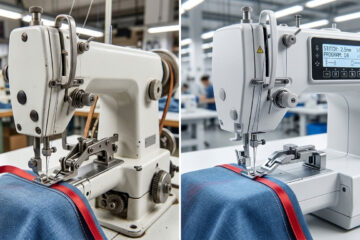
26/11/2026An acrylic sewing template is a multi-layer clear plastic fixture that clamps garment parts in the right position and order so a template sewing machine can sew them automatically. The template has a slot through which the needle and presser foot travel. What the template does not do is define the stitch path: the seam is designed in pattern CAD software, exported as a PLT/DXF file and loaded into the machine. The template simply holds the parts exactly where that file expects them.
Key points:
- Two families of “templates” on the shop floor: folders, guides and jigs on conventional machines; clamping templates for programmable template sewing machines.
- Template anatomy: base plate, top plate, optional middle plates, sewing slot, hinge, anti-slip strips, locating pins/marks, ID.
- Workflow: analyse the operation → design seam and export PLT/DXF → design template layers on the same origin → cut on a CNC → assemble → trial sew and adjust.
- Most common mistake: designing the template separately from the seam file, so the slot and needle path do not match.
What is a sewing template in garment manufacturing?
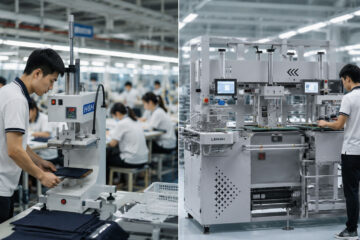
In RMG factories, “template” or “jig” means any device added to an operation to locate parts, guide the seam or combine several handling steps, instead of relying on the operator’s eye and hand. It shortens cycle time, improves consistency and cuts training time.
| Family | Examples | Used on | How it works |
|---|---|---|---|
| Folders, guides, jigs | Hemming folders, binders, pocket creasing templates, label positioning jigs | SNLS, DNLS, overlock, pressing tables | Fixed to machine or table; operator still controls the seam |
| Clamping templates (acrylic/PVC) | Collar, cuff, pocket flap, placket, patch pocket templates | Automatic template sewing machine | Parts clamped inside; machine moves the template along the programmed path |
This article covers the second family. For how the machine itself works, see template sewing machine: what it is and how it works.
What does the acrylic template do on a template sewing machine?
It is a fixture that keeps every ply in place and in sequence while the machine drives the template at speed. In practice it:
- Holds parts still as the clamp moves the template.
- Stacks plies in order when an operation combines outer fabric, interlining and lining.
- Holds material for secondary steps, such as laser cutting on machines with an integrated laser head.
Stitch shape, stitch density and start/stop points live in the PLT/DXF file. If the slot and the file disagree, the needle hits the slot edge or the seam drifts off the part.
Anatomy of a multi-layer acrylic template
A typical template has a base plate and a top plate joined by a hinge, optional middle plates, a sewing slot common to all layers, anti-slip material, locating pins or marks, and an ID.
| Component | Function | Design note |
|---|---|---|
| Base plate | Supports the parts, mounts on the machine clamp | Rigid and flat |
| Top plate | Presses parts onto the base | Clear, so the operator sees parts and marks |
| Middle plates (optional) | Separate plies; allow multi-step loading | Layer order must follow the sewing steps |
| Sewing slot | Path for needle and presser foot | Identical on every layer and matched to the seam file; width set by the machine’s presser foot |
| Hinge | Opens/closes layers for loading | High-strength tape or hinges; must not let layers shift |
| Anti-slip material | Stops fabric slipping | Sandpaper strips, Velcro, adhesive strips or magnets along slot edges |
| Locating pins / marks | Correct placement and grain alignment | Engraved/drawn lines; pin holes |
| ID | Style, operation, size | Written code; some machines read an RFID tag on the template to call the right programme |
Base and sub-templates: multi-step operations often use a base template that stays clamped throughout, plus sub-templates that add holding force at each step — see SPM vs template sewing machine.
Template materials
Templates are usually made from rigid transparent sheet — acrylic or PVC; board can be used for trial templates. Choose material that is clear, rigid and flat under multiple plies, and that machines to a clean slot edge that won’t snag fabric or thread. Sheet thickness depends on ply count, fabric thickness and the machine’s clamp height — take the values from your machine supplier.
How acrylic templates are designed and made: 6 steps
Work from the file: operation analysis → seam design and PLT/DXF export → template layer design on the same origin → CNC cutting → assembly → trial sewing.
- Analyse the operation. Define parts, plies, loading order and secondary steps. Example — 4-ply shirt collar: load 2 outer plies → cut collar shape → load 2 interlinings → load outer ply → sew 3 edges.
- Design the seam and export. Draw the stitch path in pattern CAD and export PLT/DXF per step. The path is not programmed on the machine via PLC; the machine screen only selects and loads files. See the stitch design and PLT/DXF export process.
- Design the template layers. From the seam file, draw each layer on the same origin: slot (needle path plus presser-foot clearance), laser-cut area if any, pin holes, locating marks, hinge, magnets and ID.
- Cut the template. Rout or cut the sheet on a CNC. Factories with many styles typically use a dedicated pattern template cutting machine that cuts slots and outlines and draws locating marks in one run; trial templates can be cut on board first.
- Assemble. Hinge the layers, add anti-slip strips along slot edges, fit magnets and pins, mark the ID or attach the RFID tag.
- Trial sew and document. Dry-run the programme at low speed with an empty template, then sew real fabric. Adjust file or template, then archive seam file, template file, photos and machine settings per style for repeat orders.
Common template mistakes and fixes
| Problem | Symptom | Typical cause | Fix |
|---|---|---|---|
| Needle hits slot edge | Broken needles, scratched template | Slot not matched to file; narrow foot clearance | Design template from the seam file; dry-run |
| Parts slip | Seam off edge, puckering | No anti-slip, uneven clamping | Add sandpaper/magnets along slot; check flatness |
| Layers misalign | Step seams don’t meet | Loose hinge, no locating pins | Replace hinge, add pins |
| Template warps | One corner doesn’t clamp | Sheet too thin for template size | Thicker/stiffer sheet or reinforcement |
| Wrong template used | Wrong style or size | No ID, mixed storage | Clear IDs, RFID where supported, racks by style |
Machine-side issues (file loading, skipped stitches, thread breaks) are covered in common programmable sewing machine issues.
In-house or outsourced templates?
Outsource when you are starting out with few styles; build in-house when you run many styles, change often and need control over lead time. In-house needs a template cutting machine, CAD skills and a template maker; outsourcing costs per template and depends on the vendor’s lead time, and your patterns leave the factory. Templates are a recurring cost per style — see programmable sewing machine investment cost.
Reference solutions
A factory making its own templates needs a template cutter and a template sewing machine. Data from product pages on 13/11/2026.
| Equipment | Published information | Note |
|---|---|---|
| HSM-1512B | CNC milling, cutting and drawing; working size 1200 × 1500 mm; non-metallic sheet (mica/acrylic, board) and paper; pen head for marks; dust extraction; multi-file nesting; offline operation | Max thickness, speed, file formats: ask us for the catalogue |
| K8T Series | Sewing area 80 × 45 cm to 150 × 110 cm by model; CNC control; RFID template recognition | Speed, stitch length: ask us for the catalogue |
| K10 Series | Rotating needle head for zig-zag, curves and multi-line stitching; RFID templates; optional dual feeding table | Ask us for the catalogue |
Large-area parts such as plackets, collars and pockets suit a large-format template machine. To size an in-house template room, send your parts and monthly style count via the HSM-1512B page for a quotation. If you run only a few fixed styles, an outside template maker is usually cheaper than a dedicated cutter.
FAQ
A jig or fixture that locates and holds garment parts so an operation is faster and more consistent; on template sewing machines it is a multi-layer acrylic or PVC clamp.
No. The path is designed in pattern CAD and exported as PLT/DXF. The template only holds parts; its slot must match that file.
Rigid transparent sheet — acrylic or PVC — with board for trial templates. Thickness depends on plies, fabric and the machine’s clamp height.
Analyse the operation, design the seam and export PLT/DXF, design layers on the same origin, cut on a CNC, assemble hinge/anti-slip/pins, then trial sew.
Usually because the template was drawn separately from the seam file or the slot is too narrow for the presser foot. Design from the seam file and dry-run first.
Yes if you run many styles and change often; outsource if you are starting out or have few fixed styles.
Contact us in Southeast Asia - South Asia:
- Singapore: 7 Temasek Boulevard, #43-01A Suntec Tower One, Singapore 038987.
- Vietnam - Philippines - Thailand - Cambodia: Unit 1, 3rd Floor, Building H, Street 17, Tan Thuan Export & Processing Zone, Tan Thuan Ward, HCMC, Vietnam.
- India: Sy. No. 23/8, Ground Floor, Masthappa Layout, Near Yashas Vidya Kendra School, Somashettyhalli, Chikkabanavara Post, Bangalore - 560090 , Karnataka, India.
- Bangladesh: Mizan House, 6th Floor, Flat 6/A, House 6, Road 2, Lane 1, Block G, Halishahar H/E, Chattogram, Bangladesh.
- Phone: (+84) 0983 309 910 (WhatsApp, WeChat, Zalo)
- Email: marketing@hoshima-int.com
- LinkedIn | Facebook | YouTube: Hoshima International