AI Applications in Seamless Apparel Production
06/08/2026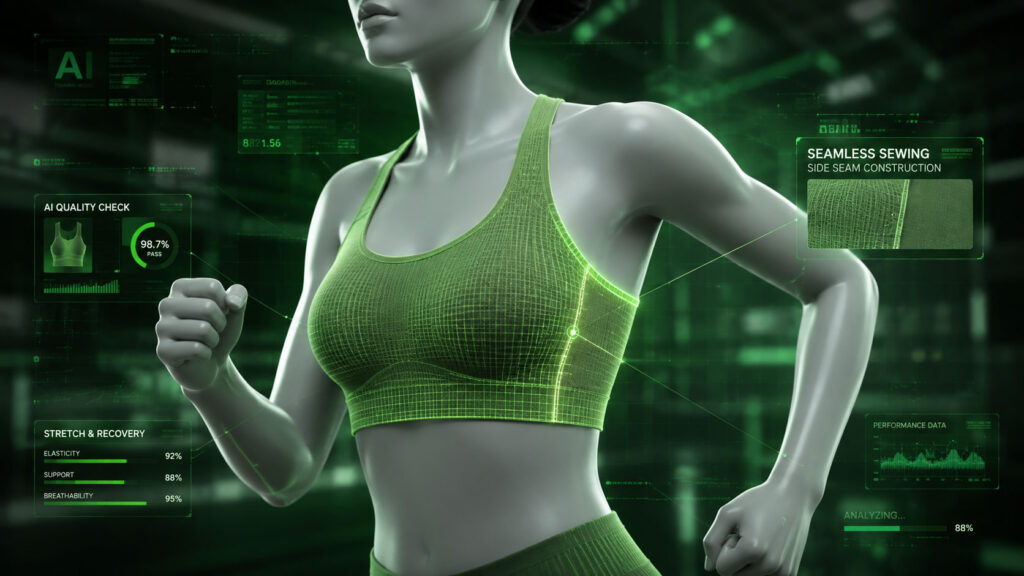
Seamless underwear and sportswear are a fast-growing trend in global garment manufacturing, prized for comfort, a sleek finish, and superior stretch. What few people realize is that behind every seamless garment lies a production process supported by AI visual recognition technology — the key enabler that replaces traditional needle-and-thread stitching with precisely applied glue bonding.
Why Is the Garment Industry Moving Toward Seamless Production?
For body-hugging products like underwear, sports bras, and activewear, traditional seams create raised ridges that press against the skin, causing discomfort during movement and visible lines through outer clothing. Seamless technology solves this by eliminating stitching entirely, joining fabric pieces together with specialized adhesive instead — producing a smooth, flat surface that stretches naturally in every direction.
The Biggest Challenge in Seamless Production: Glue-Line Precision
The core challenge with bonding technology is that even a few millimeters of glue-line deviation results in a defective piece — excess glue bleeding outside the target area stiffens the fabric, while insufficient glue leaves a weak, unreliable joint. With traditional manual methods (using a fixed jig, with operators placing fabric at predetermined coordinates), accuracy depends entirely on whether the fabric is placed exactly at the fixed position — while soft, stretchy fabric is highly prone to shifting during handling.
How Does AI Solve This Problem?
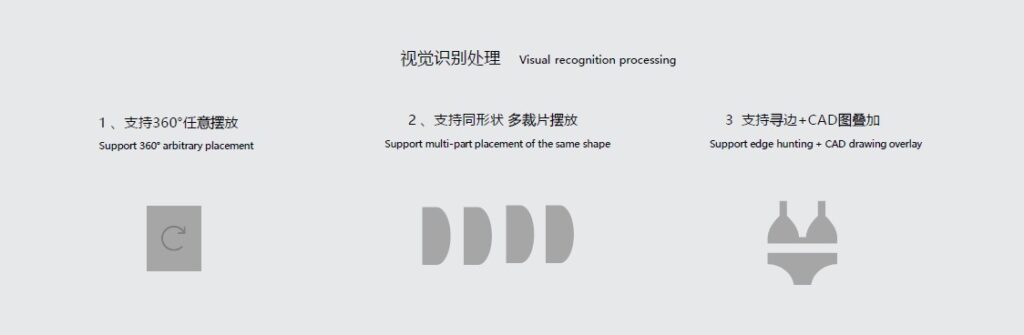
This is the real breakthrough of the new technology: instead of requiring fabric to be placed at an exact fixed coordinate, an AI visual recognition camera system enables the machine to:
- Automatically detect the fabric part the moment it’s placed on the work table, regardless of whether its position and angle are perfectly aligned.
- Automatically calculate the glue path based on the actual detected shape of the fabric part — combining edge-hunting technology with a pre-programmed CAD data overlay.
- Automatically reprogram the glue nozzle according to the newly calculated path, with no manual reprogramming required for each new batch.
Thanks to this mechanism, operators can place fabric at any 360° angle without compromising accuracy — the machine automatically adjusts to the actual position instead of requiring the operator to achieve perfect placement.
Benefits of AI Technology in Seamless Production
- Higher precision than manual handling: the AI system can detect and correct millimeter-level position deviations that are difficult for the human eye to catch.
- Flexibility when switching styles: no need to build a separate fixed jig for each fabric pattern, giving factories more flexibility for small, varied production runs.
- Reduced dependency on operator skill: operators no longer need the precise manual alignment skills previously required, giving factories more flexibility in hiring.
- Significant productivity gains: thanks to parallel processing across multiple stations and less time lost to positioning errors, output can increase substantially compared to traditional manual/fixed-jig methods.
A Few Limitations to Consider
- Higher upfront investment cost compared to traditional fixed-jig glue dispensers, due to the added camera and image-processing system.
- Requires periodic camera/sensor system maintenance to ensure detection accuracy doesn’t degrade over time.
- Not suited to every fabric type — factories should carefully evaluate fabrics with high reflectivity or colors that may be challenging for the visual recognition system.
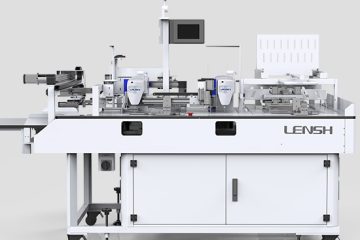
Real-World Example: LS-2182A AI Vision Automatic Dispensing Machine
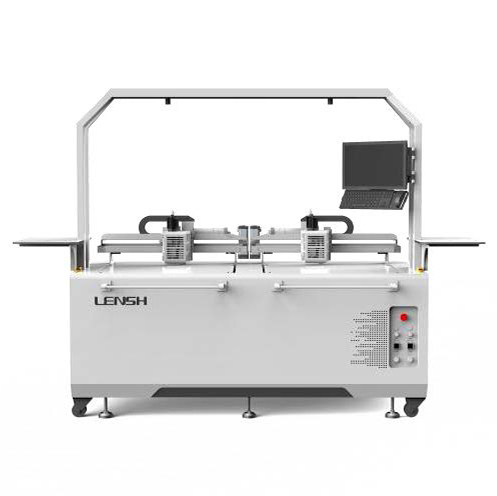
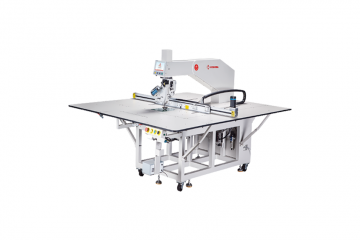
A concrete example already in real-world use is a dual-head glue dispensing machine integrated with AI camera vision, supporting 360° arbitrary fabric placement, automatically calculating the glue path based on the actual detected fabric shape, and processing two stations in parallel — delivering an efficiency increase of roughly 210% compared to traditional dispensers without camera vision.
📖 See full technical specifications on the product page: LS-2182A AI Vision Automatic Dispensing Machine
Frequently Asked Questions
No. This technology only applies to the fabric-joining operation, replacing stitching with glue bonding for products requiring a smooth, flat surface (underwear, high-stretch sportswear). Other operations in the production process still require standard sewing machines.
A fixed jig requires fabric to be placed at an exact coordinate, while soft fabric is highly prone to shifting during handling. An AI camera solves this by automatically detecting the fabric’s actual position and adjusting the glue path accordingly, instead of requiring the operator to achieve perfect placement.
This should be evaluated based on the factory’s volume and style variety. If the factory frequently changes patterns and needs high flexibility, AI technology can deliver greater value relative to the upfront investment, since it eliminates the need to build a separate jig for each pattern.
Contact us in Southeast Asia - South Asia:
- Singapore: 7 Temasek Boulevard, #43-01A Suntec Tower One, Singapore 038987.
- Vietnam - Philippines - Thailand - Cambodia: Unit 1, 3rd Floor, Building H, Street 17, Tan Thuan Export & Processing Zone, Tan Thuan Ward, HCMC, Vietnam.
- India: Sy. No. 23/8, Ground Floor, Masthappa Layout, Near Yashas Vidya Kendra School, Somashettyhalli, Chikkabanavara Post, Bangalore - 560090 , Karnataka, India.
- Bangladesh: Mizan House, 6th Floor, Flat 6/A, House 6, Road 2, Lane 1, Block G, Halishahar H/E, Chattogram, Bangladesh.
- Phone: (+84) 0983 309 910 (WhatsApp, WeChat, Zalo)
- Email: marketing@hoshima-int.com
- LinkedIn | Facebook | YouTube: Hoshima International