Programmable Sewing Machine Investment Cost: Is It Worth It vs a Mechanical Machine?
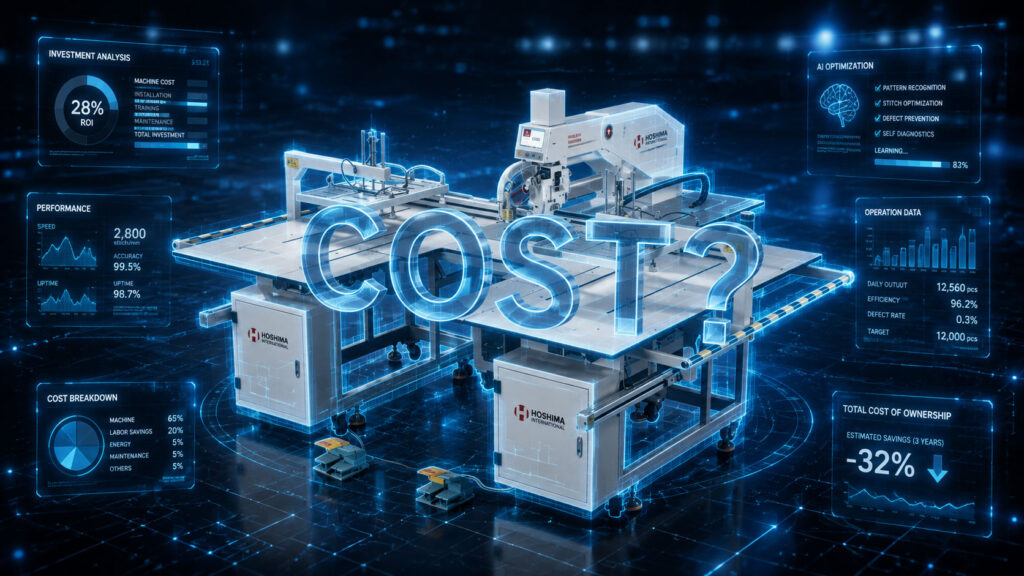
19/08/2026The upfront cost of a programmable sewing machine is typically several times higher than a mechanical machine, due to the added electronic control unit, servo motor, and (depending on the type) specialized jigs or templates. However, this cost difference is usually offset within 12–30 months through faster production, lower defect rates, and reduced dependence on highly skilled labor — provided the factory has enough stable volume to make full use of the machine’s capacity. For small, frequently changing orders, the payback period can stretch out considerably, or may never fully materialize.
(The percentages and timeframes in this article are a reference framework based on common industry operating patterns; exact figures should be confirmed against real supplier quotes for the specific machine model and factory scale.)
What Makes Up the Investment Cost of a Programmable Sewing Machine
The investment cost is not just the machine’s purchase price. Here are the cost items to account for before making a decision:
| Cost Item | Applies To | Notes |
|---|---|---|
| Machine price (hardware + control unit) | Both SPM and Template Sewing | The largest single cost, varying by brand and programming level (semi/full) |
| Pattern design software (dedicated CAD) | Both types | License cost; often a one-time purchase usable across multiple machines in the factory |
| Fixed jig/fixture fabrication | SPM only | Design + fabrication of a fixed jig for one specific operation, typically a one-time cost |
| Acrylic (mica) template fabrication | Template Sewing only | Recurs with each new style/operation — a repeating cost, unlike the one-time SPM jig cost |
| Staff training | Both types | Training for pattern-design technicians, machine operators, and maintenance technicians |
| Maintenance & consumables | Both types | Needles, thread, machine oil, replacement electronic parts (sensors, control boards) |
| Downtime during changeover | Mainly Template Sewing | Time spent swapping templates and reloading programs between orders |
| Learning-curve opportunity cost | Both types | Output is typically below rated machine capacity during the initial ramp-up period |
Cost Comparison: Mechanical vs Programmable Sewing Machine
| Criteria | Mechanical Machine | Programmable Sewing Machine (SPM/Template) |
|---|---|---|
| Upfront investment | Low | Significantly higher (control unit, servo motor, software, jig/template) |
| Operator training cost | Low — pedal-driven skills are widely available | Moderate — operators need training on machine handling and program loading, but not high pedal-driven skill |
| Cost from defective output | Higher — depends heavily on operator skill, inconsistent across batches | Lower — high consistency, fewer operator-driven errors |
| Maintenance cost | Low — simple mechanical construction | Higher — requires electrical/electronics technicians and specialized replacement parts |
| Production speed | Skill-dependent, hard to scale quickly | Stable and predictable |
| Foundation for further automation (SPM/AI/laser, etc.) | No | Yes — a required foundation |
Cost Comparison: SPM vs Template Sewing Machine
This is a distinction many investors miss when comparing “programmable sewing machines” as a single category against mechanical machines — in reality, the cost structure differs meaningfully between SPM and Template Sewing:
| Criteria | SPM | Template Sewing |
|---|---|---|
| Initial jig/template cost | One-time, fixed for one operation | Recurs with each new style/operation |
| Cost when switching to a new style/order | High — usually requires a new jig or a new machine | Moderate — only a new acrylic template needs to be designed and cut; the machine stays the same |
| Frequency of jig/template design staff cost | Lower — designed once, used long-term | Higher — needs a template-design team working regularly if the order mix is varied |
| Best economics at scale | Best with high, stable, long-running volume | Best with varied orders needing frequent flexibility |
| Risk of a “stranded” investment if orders change | High — the jig cannot be reused for a different operation | Lower — the machine remains usable; only a new template is needed |
Quick decision guide: if a factory can commit to running one operation at stable volume for at least 12–18 months, an SPM typically delivers the lowest cost per unit. If the product mix or order pattern changes seasonally, Template Sewing reduces the risk of a stranded investment tied to a single operation.
Staffing Required to Operate a Programmable Sewing Machine
One area investors commonly underestimate: staffing cost is not just the machine operator. Running this equipment effectively requires a coordinated set of roles:
| Role | Main Responsibility | Applies To |
|---|---|---|
| Pattern design technician (CAD/CAM) | Designs the stitch pattern on software, exports PLT/DXF files | Both SPM and Template Sewing — a required role that directly determines stitch quality |
| Program loading & machine setup technician | Loads files onto the machine, aligns the jig/template, runs test cycles before mass production | Both types; this workload is higher for Template Sewing due to frequent template changes |
| Machine operator | Runs the machine, monitors the sewing process, handles basic issues (thread breaks, fabric jams) | Both types — requires lower skill than a mechanical machine, but needs to understand the standard process |
| Electrical/electronics maintenance technician | Maintains the control unit, sensors, servo motor; troubleshoots board-level faults | Both types — a required role, distinct from purely mechanical machine maintenance |
| Jig/template fabricator | Machines metal jigs (for SPM) or cuts acrylic templates (for Template Sewing) to design specs | SPM: as needed, less frequent. Template Sewing: needed more regularly if the order mix is varied |
| Line supervisor / production coordinator | Schedules template/program changeovers, tracks actual output against rated capacity | Both types, more critical for Template Sewing due to higher changeover frequency |
Note on staffing scale: not every factory needs all six roles as separate, dedicated positions. In small-to-mid-size factories, one technician can often cover both pattern design and program loading. In larger factories, or those running multiple SPM/Template Sewing lines in parallel, separating these roles helps maintain changeover speed between orders.
A Simple Way to Estimate Payback Period (ROI)
Reference framework:
Payback period (months) = Additional investment cost vs a mechanical machine
                           ÷ (Monthly labor cost savings + Monthly value of reduced defects)
Where:
- Additional investment cost: the difference between the total programmable sewing machine cost (including jig/template and training) and the cost of an equivalent mechanical machine.
- Monthly labor cost savings: savings from needing fewer highly skilled workers, or from higher output per machine.
- Monthly value of reduced defects: the reduction in defect rate multiplied by the average value per unit.
Factories should plug in their own real numbers rather than relying on industry-wide averages, since savings depend heavily on production volume, regional labor cost, and the factory’s current defect rate.
When Is This Investment Actually Worth It?
Worth investing when:
- The target operation is expected to run at stable, high volume for at least 12 months or more.
- The factory is struggling to hire highly skilled operators or is facing rapidly rising labor costs.
- Customer stitch-quality requirements (especially for export orders) are strict, and the current defect rate is causing significant losses.
- The factory has a long-term automation roadmap (adding more SPM/Template Sewing machines for other operations later) — the upfront staff training investment carries over to future machines.
Worth reconsidering or delaying when:
- Orders are small and styles change frequently week to week or month to month, not stable enough to make full use of machine capacity.
- The factory does not yet have a pattern-design/CAD team in place — the cost and time to build this team should be factored in before the machine can operate effectively.
- The investment budget is tight and there’s no cash-flow buffer for a 12–30 month payback period.
Frequently Asked Questions
There’s no fixed figure, since it depends on the brand, programming level (semi/full), and the associated jig/template cost. In general, the upfront investment is significantly higher than a mechanical machine, but most of that cost is offset through faster production and fewer defects within 12–30 months if volume is sufficient.
An SPM usually has a lower initial jig cost (built once), but carries the risk of becoming a stranded investment if the operation changes. Template Sewing has a recurring acrylic template cost per style, but offers more flexibility and lower risk of over-investment when orders change frequently.
At minimum: one machine operator, plus a shared pattern-design technician and a shared electrical/electronics maintenance technician who can support multiple machines in the factory (not a strict 1:1 ratio per machine). Template Sewing requires more frequent template-fabrication resources if the order mix is varied.
Yes — many machine suppliers provide basic operational training as part of the handover. However, the pattern-design (CAD) role usually benefits from more structured training or hiring an experienced technician, since it directly determines stitch quality.
Contact us in Southeast Asia - South Asia:
- Singapore: 7 Temasek Boulevard, #43-01A Suntec Tower One, Singapore 038987.
- Vietnam - Philippines - Thailand - Cambodia: Unit 1, 3rd Floor, Building H, Street 17, Tan Thuan Export & Processing Zone, Tan Thuan Ward, HCMC, Vietnam.
- India: Sy. No. 23/8, Ground Floor, Masthappa Layout, Near Yashas Vidya Kendra School, Somashettyhalli, Chikkabanavara Post, Bangalore - 560090 , Karnataka, India.
- Bangladesh: Mizan House, 6th Floor, Flat 6/A, House 6, Road 2, Lane 1, Block G, Halishahar H/E, Chattogram, Bangladesh.
- Phone: (+84) 0983 309 910 (WhatsApp, WeChat, Zalo)
- Email: marketing@hoshima-int.com
- LinkedIn | Facebook | YouTube: Hoshima International