Mechanical vs. Electronic Industrial Sewing Machine: Pros, Cons & Which One to Invest In
22/07/2026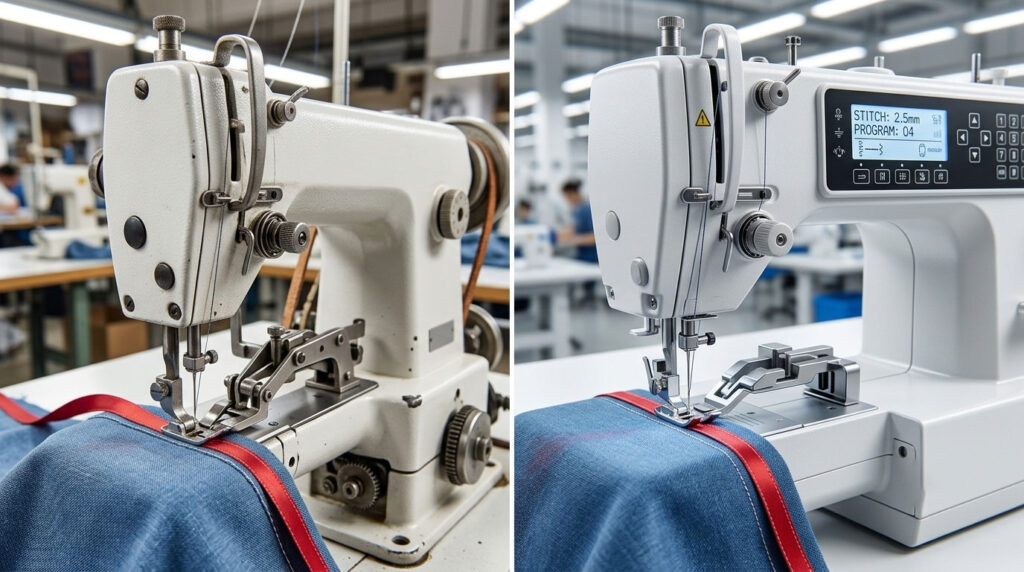
A mechanical sewing machine operates entirely through mechanical parts — speed and auxiliary actions (thread trimming, presser foot lifting) are all controlled manually by the operator. An electronic sewing machine adds a control board, a direct-drive motor, and sensors, enabling partial automation of operations and parameter adjustment through a control panel.
📌 Note: “Electronic sewing machine” in this article is used in the broad sense — covering everything from direct-drive motor models with automatic thread trimming, up to machines with a full programmable controller. If you want to go deeper into fully programmable machines specifically, see: “What Is a Programmable Sewing Machine? Should You Upgrade From Mechanical Machines?”
Comprehensive Comparison Table
| Criteria | Mechanical Machine | Electronic Machine |
|---|---|---|
| Initial investment cost | Lower | Higher (typically 30–70% more, depending on features) |
| Operating noise level | Higher (belt-driven, separate clutch motor) | Lower (direct-drive motor, quieter operation) |
| Power consumption | Clutch motor draws power continuously, even when not sewing | More energy-efficient — motor engages only when needed |
| Thread trimming | Manual | Automatic (on most electronic models) |
| Seam accuracy | Depends on operator skill | More consistent, supported by electronic control |
| Maintenance & repair | Simple, common spare parts, technicians widely available | More complex, requires technicians with electronics expertise |
| Long-term durability | High, fewer issues from electronic components | Depends on component quality; circuit issues may develop over extended use |
| Best suited for | Small factories, limited budget, prioritizing low cost and easy repairs | Mid-to-large factories, prioritizing output, consistency, and long-term energy savings |
Pros and Cons of Mechanical Sewing Machines
Pros:
- Low investment cost, suitable for newly established factories or limited budgets.
- Simple construction, spare parts and repair technicians easy to find in most locations.
- Fewer issues from electronic components; long mechanical lifespan with proper maintenance.
Cons:
- Speed and precision depend entirely on operator skill.
- Continuous power draw from the clutch motor, even when the machine isn’t sewing.
- Noisier operation, which can affect the working environment when many machines run simultaneously.
Pros and Cons of Electronic Sewing Machines
Pros:
- Energy savings thanks to a direct-drive motor that only draws power when needed.
- Quieter operation, improving the factory floor environment.
- Automatic thread trimming reduces manual steps and increases production speed.
- More consistent seams across pieces, reducing dependency on operator skill.
Cons:
- Significantly higher upfront investment cost compared to mechanical machines.
- When circuit-related faults occur, specialized technicians are needed — not every mechanical repair technician can handle electronic faults.
- Electronic component failures can develop over extended use, particularly with lower-cost models using unbranded components.
So Which One Should You Invest In?
The decision should be based on factory scale, budget, and long-term goals — there’s no single correct answer for every situation:
- Prioritize mechanical machines if: the factory is newly established, budget is limited, and you need to minimize upfront investment while having easy access to local repair technicians.
- Prioritize electronic machines if: the factory is already stable, handles high-volume orders requiring speed and consistency, or is factoring in long-term energy savings when running many machines simultaneously.
- Combine both: many factories use electronic machines for core, high-volume operations, while keeping mechanical machines for secondary operations or as backup — a balanced strategy between cost and efficiency.
Frequently Asked Questiones
Yes, due to the direct-drive motor design that only draws power while the machine is actually sewing, unlike the clutch motor on mechanical machines, which typically draws power continuously even when idle. For factories running many machines over long hours, this energy savings can be significant after a few years of operation.
Somewhat, yes. Faults related to the electronic control board require technicians with electronics expertise — not every general mechanical repair technician can handle these issues. This is worth factoring in when choosing a supplier with strong warranty and technical support services.
It depends on budget and growth plans. If budget is limited and order volume isn’t yet stable, mechanical machines are the safer choice. If the factory has a long-term growth plan with high order volumes from the start, investing in electronic machines early may be more cost-effective over time.
Contact us in Southeast Asia - South Asia:
- Singapore: 7 Temasek Boulevard, #43-01A Suntec Tower One, Singapore 038987.
- Vietnam - Philippines - Thailand - Cambodia: Unit 1, 3rd Floor, Building H, Street 17, Tan Thuan Export & Processing Zone, Tan Thuan Ward, HCMC, Vietnam.
- India: Sy. No. 23/8, Ground Floor, Masthappa Layout, Near Yashas Vidya Kendra School, Somashettyhalli, Chikkabanavara Post, Bangalore - 560090 , Karnataka, India.
- Bangladesh: Mizan House, 6th Floor, Flat 6/A, House 6, Road 2, Lane 1, Block G, Halishahar H/E, Chattogram, Bangladesh.
- Phone: (+84) 0983 309 910 (WhatsApp, WeChat, Zalo)
- Email: marketing@hoshima-int.com
- LinkedIn | Facebook | YouTube: Hoshima International
Hoshima specializes in automation solutions for the garment industry, offering:
-> Read more related articles: