What Is a Fabric Spreading Machine? Parts, Spreading Modes and How to Choose
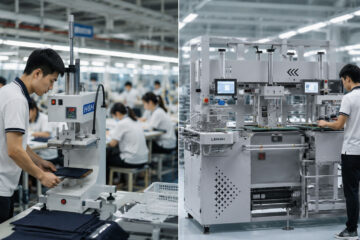
16/11/2026A fabric spreading machine travels along the cutting table and lays a fabric roll into a multi-ply lay of the exact marker length, keeping every ply flat, edge-aligned and free of tension, so the cutter receives a lay it can cut accurately. Spreading sits between fabric inspection/relaxing and cutting in the cutting room; a poor lay produces off-size panels however good the cutter is.
Key points:
- What it does: carries the roll back and forth, lays each ply, aligns the selvedge, cuts or folds at the lay ends and counts plies.
- Main modes: face-one-way (F/O/W) and face-to-face zigzag (F/F).
- Levels: manual spreading, semi-automatic (operator-pushed) spreaders, automatic spreaders (self-driven, auto edge control, ply counting).
- When a machine pays off: high lays, high volumes, stretch fabrics that are hard to spread evenly by hand, and cutting rooms running automatic multi-ply cutters.
Where does spreading fit in the cutting department?
Spreading is a core function of the cutting department: it converts inspected and relaxed rolls into lays that match the marker. In the cutting room procedure it follows fabric inspection, relaxing and marker making, and precedes cutting.
A good lay has: flat plies with no wrinkles or bowing; at least one straight, aligned edge; even, minimal tension; correct ply length and ply count per the cut plan; correct fabric face orientation.
Parts of a fabric spreading machine
A spreader has five main assemblies — carriage, roll cradle, tension-controlled feed, edge control and end cutter/catcher — plus a controller and sensors on automatic models.
| Assembly | Function | Buying note |
|---|---|---|
| Carriage & wheels | Travels along the table rails | Table length and flatness affect accuracy |
| Roll cradle / creel | Holds roll or flat-folded fabric | Max roll weight and diameter |
| Feed & tension control | Feeds fabric at the same speed as the carriage so it is not pulled | Critical for knits and elastane |
| Edge control | Sensor tracks the selvedge and shifts the roll so plies line up | Check edge tolerance |
| End cutter / catcher | Cuts each ply (one-way) or holds the fold (zigzag) | Knife type, cycle time |
| Controller & sensors | Ply length, ply count, speed; auto stop at count or roll end | Fabric profiles, data export |
Many automatic lines add a fabric loader to lift heavy rolls onto the spreader without manual handling.
Fabric spreading modes
The two main modes are face-one-way (every ply in the same direction, cut at each end) and face-to-face zigzag (continuous back-and-forth, folded at the ends); the choice depends on whether the fabric is directional and whether panels are needed in mirrored pairs.
| Mode | How | Use for | Watch-outs |
|---|---|---|---|
| Face one way (F/O/W) | Each ply laid in one direction, face up; cut at end, carriage returns | Directional fabrics: nap, pile, velvet, one-way prints, shaded sheen | Slower (empty return); end loss on every ply |
| Face to face zigzag (F/F) | Lay out and back continuously, plies face to face, folded at ends | Non-directional fabrics; mirrored left/right panels | Fastest; not for directional fabrics |
| Face to face, one way | Plies face to face but all in one direction | Directional fabric needing mirrored pairs | Needs a turning/turntable mechanism |
| Tubular | Spreading circular-knit tubes | Tubular knit bodies | Requires tubular configuration |
Manual vs. machine spreading
Manual spreading still suits small orders, low lays and frequent style changes; a spreader wins on high lays, volume and difficult fabrics.
| Manual | Semi-automatic | Automatic | |
|---|---|---|---|
| Manpower | Usually 2 per table | 1–2 pushing | 1 supervising |
| Tension | Skill-dependent | More consistent | Controlled, synchronised feed |
| Edge alignment | By eye | Guides | Sensor-controlled |
| Ply count / length | Manual | Manual / partial | Automatic, logged |
| Investment | Low | Medium | High |
| Best for | Samples, small lots, single-ply | Mid-size units | High-volume rooms with automatic cutters |
Benefits and limits
Benefits: consistent lays and panel accuracy · tighter control of end losses and roll splices · cutter utilisation (an automatic cutter idles if spreading can’t keep up) · less heavy lifting and fewer injuries · data on plies, length and wastage for consumption control.
When not to invest yet: if the cutting room mostly cuts single plies (samples, leather, stripe-matching jobs), runs very small lots with constant changeovers, or has no multi-ply cutter yet. For single-ply needs, see our guide to multi-ply vs single-ply cutting machines.
How to choose a fabric spreading machine — 7 criteria
- Main fabrics: woven, knit, high-stretch, tubular, flat-folded — tension control is decisive for stretch.
- Maximum fabric width (including home textiles if relevant).
- Maximum roll weight and diameter.
- Maximum lay height — must match your multi-ply cutter.
- Modes required: F/O/W, F/F zigzag, F/F one-way, tubular.
- Extras: automatic edge control, fabric profiles, marker projection for defect avoidance, ERP data link.
- After-sales: local technicians, spares, operator training — check coverage in your cluster (e.g. Dhaka/Gazipur, Tiruppur, Bangalore, NCR).
Reference solution: Cosma Venus spreaders
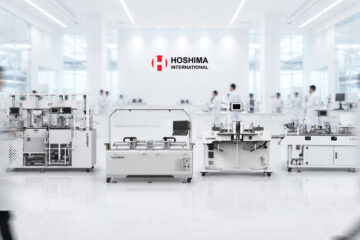
Hoshima’s South Asia partner offers the Cosma Venus spreader series; the figures below are as published on the product pages and are for reference only.
| Published item | Details |
|---|---|
| Product | Cosma Venus series fabric spreading machine |
| Materials | Flat-folded knitwear, sportswear, wovens; from high-elastane fabrics to denim |
| Modes | Open width or zig-zag |
| Specs | Spreading width 150–350 cm · fabric weight 120–300 kg (model-dependent) · lay height 25 cm · roll diameter 70 cm · max speed 125 m/min |
| Extras | Edge alignment sensors · Data Collection System (DCS) for operation data |
| Loading | Optional Cosma Automated Fabric Loader to load rolls without manual lifting |
Fits: an automatic fabric spreader suits high-volume multi-ply cutting rooms using automatic cutters such as Hoshima Rapido or the Cosma automatic cutter.
Watch-outs: specs vary by model — ask us for the catalogue for your width and roll weight, and trial with your most difficult fabric.
FAQ
A machine that lays fabric from a roll into flat, edge-aligned, tension-free plies of the marker length before cutting.
Face-one-way (all plies in one direction, cut at each end), face-to-face zigzag (continuous, folded at ends), face-to-face one-way, and tubular spreading.
Face-one-way, so nap, pile or one-way prints run the same way on every ply and panels don’t shade.
Yes, if it has synchronised, tension-free feeding. Stretch knits should also be relaxed before spreading.
When lays are high, volumes are large, manual spreading can’t keep up with the cutter, or lay quality varies between shifts.
The spreader builds the lay; the cutter cuts it to the marker. They should be matched on width and lay height — see the industrial fabric cutting machine guide.
Contact us in Southeast Asia - South Asia:
- Singapore: 7 Temasek Boulevard, #43-01A Suntec Tower One, Singapore 038987.
- Vietnam - Philippines - Thailand - Cambodia: Unit 1, 3rd Floor, Building H, Street 17, Tan Thuan Export & Processing Zone, Tan Thuan Ward, HCMC, Vietnam.
- India: Sy. No. 23/8, Ground Floor, Masthappa Layout, Near Yashas Vidya Kendra School, Somashettyhalli, Chikkabanavara Post, Bangalore - 560090 , Karnataka, India.
- Bangladesh: Mizan House, 6th Floor, Flat 6/A, House 6, Road 2, Lane 1, Block G, Halishahar H/E, Chattogram, Bangladesh.
- Phone: (+84) 0983 309 910 (WhatsApp, WeChat, Zalo)
- Email: marketing@hoshima-int.com
- LinkedIn | Facebook | YouTube: Hoshima International