What Is Fabric Relaxation and Why Does It Matter Before Cutting?
19/11/2026Fabric relaxation (fabric relaxing) is the pre-cutting step in which a fabric roll is released from winding tension and left in a tension-free state so it can shrink back to stable dimensions before spreading and cutting. Knitting, dyeing, finishing and rolling all stretch the fabric; if it is cut straight away, the panels keep shrinking after cutting and come out undersized, off-spec and difficult to sew.
Key points:
- Purpose: release built-in tension so dimensions are stable at cutting.
- Most critical for: knits, elastane/Lycra blends and high-stretch fabrics; wovens per buyer requirement.
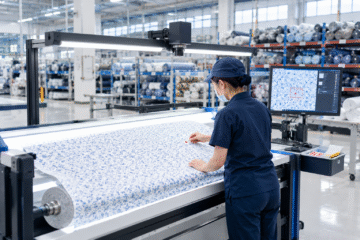
- Two approaches: static relaxing (unroll and rest on racks/tables) and machine relaxing (tension-free roll-to-roll feeding with loops, air flotation or, on some machines, steam).
- Control: measure width and length before and after, log time, track by lot.
Where does relaxing sit in the RMG pre-production flow?
Relaxing follows fabric inspection and comes before marker making on actual width, spreading and cutting. It belongs to the pre-production (PPA) stage and is step 2 of a typical cutting room procedure.
- Fabric receipt and inspection — see our fabric inspection guide.
- Relaxing.
- Marker making on post-relax width.
- Spreading and cutting.
Why relax fabric before cutting?
Because unrelaxed fabric continues to shrink after cutting, so panels end up smaller than the pattern, plies in the same lay shrink unevenly and garments fail measurement checks. Typical problems:
- Post-cut shrinkage — bodies, sleeves and rib panels come out short against the spec sheet.
- Ply-to-ply variation — top and bottom plies shrink differently.
- Sewing issues — mating panels differ in length, causing puckering or twisting.
- Wrong consumption — markers built on stretched width don’t match the real width.
Relaxed fabric also spreads better on high-speed spreaders (see fabric spreading), which work best when the fabric is already stable.
Which fabrics need relaxing?
| Fabric group | Need | Why |
|---|---|---|
| Knits (single jersey, rib, interlock, fleece) | High | Loop structure stretches during rolling |
| Elastane / Lycra blends, high-stretch | High | Elastic yarns recover strongly once tension is released |
| Light synthetics, tubular knits | Medium | Distort easily on rolling and spreading |
| Cotton wovens, denim | Buyer-dependent | Usually more stable; many manuals still set a minimum relax time |
| Mill pre-shrunk wovens | Lower | Verify by measurement before skipping |
Fabric relaxation time: how long should fabric be relaxed?
There is no single figure: relaxing time depends on fabric construction, fibre content, method (static or machine), store temperature and humidity, and the buyer manual. Our own cutting room procedure quotes roughly 12–48 hours depending on material for static relaxing; machine relaxing usually shortens this because the fabric is unwound and fed tension-free.
Set your own standard:
- Start with the buyer’s minimum time, if specified.
- Run an internal trial: mark and measure a reference section at several time points after unrolling; relaxation is complete when dimensions stop changing.
- Record results by fabric type and mill and use them as the standard for future lots.
Static vs. machine relaxing
| Method | How | Pros | Cons |
|---|---|---|---|
| Static on racks/tables | Unroll and lay fabric loosely in layers or folds | Low cost, immediate | Space- and time-hungry; operator-dependent; hard to trace |
| Loosened roll | Slacken the roll and store it lying flat | Little space | Core of the roll stays under tension |
| Machine relaxing | Machine unwinds and feeds fabric tension-free (loops, air flotation, steam on some models), then re-rolls or folds | Fast, consistent, measures width/length, logs data | Investment; choose the right machine type for your fabrics |
Relaxing procedure: five control points
- Measure before — width and length of a marked reference section.
- Relax correctly — never let fabric hang under its own weight or stand rolls on end; lay knits flat or in loose folds.
- Respect the time standard for that fabric.
- Measure after — if width changes significantly, update the marker width.
- Record roll ID, lot, start/end time and measurements — essential evidence if finished garments fail measurement.
Relaxing vs. pre-shrinking vs. shrinkage testing
Relaxing only removes tension from rolling and handling; pre-shrinking (compacting, sanforising) is a mill finishing process that reduces wash shrinkage; shrinkage testing is a lab test measuring dimensional change after washing. They complement each other — pre-shrunk fabric may still need relaxing, and relaxed fabric can still shrink in washing if it was not pre-shrunk.
Reference solution: C-Tex Relax machine
For factories short of relaxing space or needing measured data, a relaxing machine is one option; details below are as published on the product page and are for reference only.
| Published item | Details |
|---|---|
| Product | C-Tex Relax fabric relaxing machine (UK) |
| Purpose | Relaxes tension-sensitive elastomeric and Lycra fabrics so they can be spread on automated spreaders |
| Process | Roll-to-roll; two relaxation stages — lazy-loop and air flotation; edge control |
| Specs | Speed 0–60 m/min · fabric width 2,500 mm · standard roll Ø 450 mm, 80 kg (larger/heavier on request) · 240 V, 50 Hz, single phase |
| Data | Automatic width monitoring, calibrated digital length wheel, automated data collection |
Fits: knit and stretch-heavy units feeding automatic spreaders such as the Cosma Venus spreader.
Not needed when: you mainly cut stable wovens, stretch volumes are low, and you have space and a disciplined static relaxing procedure. Related pre-cutting checks: C-tex fabric inspection machine and C-Tex colour inspection.
FAQ
Releasing a fabric roll from winding tension and letting it rest tension-free so it shrinks back to stable dimensions before cutting.
So it does not keep shrinking after cutting, which would make panels undersized, plies inconsistent and markers inaccurate.
It depends on the fabric, method and buyer. Measure a reference section over time and fix the point where dimensions stop changing.
Knits and elastane/Lycra blends almost always; stable wovens depending on the buyer manual and your measurements.
No. Relaxing removes rolling tension; pre-shrinking is a mill finishing process against wash shrinkage, verified by shrinkage tests.
No. Unroll the fabric and lay it flat or in loose folds so tension is released evenly.
Contact us in Southeast Asia - South Asia:
- Singapore: 7 Temasek Boulevard, #43-01A Suntec Tower One, Singapore 038987.
- Vietnam - Philippines - Thailand - Cambodia: Unit 1, 3rd Floor, Building H, Street 17, Tan Thuan Export & Processing Zone, Tan Thuan Ward, HCMC, Vietnam.
- India: Sy. No. 23/8, Ground Floor, Masthappa Layout, Near Yashas Vidya Kendra School, Somashettyhalli, Chikkabanavara Post, Bangalore - 560090 , Karnataka, India.
- Bangladesh: Mizan House, 6th Floor, Flat 6/A, House 6, Road 2, Lane 1, Block G, Halishahar H/E, Chattogram, Bangladesh.
- Phone: (+84) 0983 309 910 (WhatsApp, WeChat, Zalo)
- Email: marketing@hoshima-int.com
- LinkedIn | Facebook | YouTube: Hoshima International