What Is a Special Purpose Machine (SPM)? How It Differs From Standard Industrial Sewing Machines
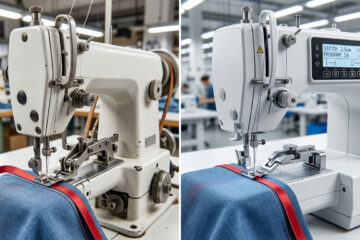
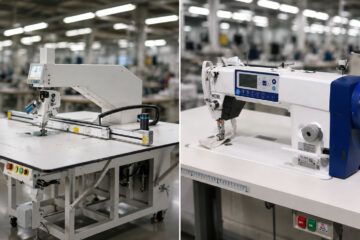
20/07/2026A Special Purpose Machine (SPM) is an industrial sewing machine — typically a programmable machine — fitted with an additional jig, fixture, and template (semi-automated) system to automate one specific sewing operation, rather than performing a wide range of stitch types like a standard industrial sewing machine.
How Does an SPM Actually Work?
In garment manufacturing, not every operation can be fully automated from start to finish the way it can in mechanical or electronics manufacturing. Most operations still require skilled manual handling. However, for operations that are repetitive and follow a fixed process (such as pocket setting, zipper attaching, or collar binding), a factory can convert an existing programmable sewing machine into a dedicated SPM by adding:
- Jig: precisely positions the fabric part before sewing.
- Fixture: holds the fabric part firmly in place throughout the sewing cycle, preventing shifting.
- Template: guides the sewing path according to the fixed shape required for that specific operation.
Combined with a programmable sewing machine, these three components turn the machine into a semi-automated device dedicated to exactly one operation — the operator simply places the fabric part in the correct position, and the machine automatically completes the rest according to the pre-installed template.
SPM vs. Standard Industrial Sewing Machine
| Criteria | Standard Industrial Sewing Machine | Special Purpose Machine (SPM) |
|---|---|---|
| Application scope | Versatile — handles many different seam types | Dedicated to one fixed operation |
| Level of automation | Heavily dependent on operator skill | Semi-automated via jig/fixture/template system |
| Consistency across output | Depends on skill, can vary | High and stable across batches |
| Operator skill requirement | High — skilled operators needed for complex seams | Lower — operators mainly place/remove fabric parts |
| Speed for that specific operation | Average | Significantly higher (typically 200–350% increase, depending on the operation) |
| Investment cost | Lower (general-purpose machine) | Higher, but optimized for high-volume operations |
| Real-world examples | Standard 1-needle, 2-needle machines | Zipper pre-expansion machine, AI glue dispensing machine, 5-head automatic heat transfer machine |
Why Should a Factory Consider Investing in an SPM?
- Significant productivity gains for high-volume operations: because the machine is purpose-built for exactly one task, no time is lost adjusting for different seam types.
- Reduced dependency on operator skill: the jig/fixture/template system ensures consistent quality even with newly-trained operators.
- Lower defect rate from manual handling errors: particularly valuable for operations prone to misalignment, such as zipper attaching, logo pressing, or glue bonding on soft/stretch fabric.
- Better long-term cost efficiency: although the upfront investment is higher than a standard machine, high-volume operations typically see fast payback due to the significant productivity gain.
Common Operations That Get “Converted” into SPMs
- Zipper tape pre-treatment: a dedicated pre-expansion machine prevents wavy seam defects after the zipper is sewn in.
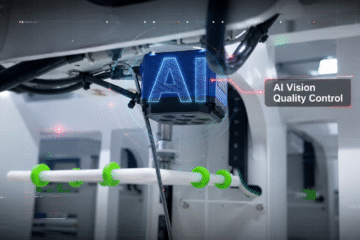
- Bonding for seamless garments: an AI-camera-equipped dispensing machine automatically detects fabric parts and calculates the glue path, replacing traditional sewing on seamless underwear and high-stretch sportswear.
- Bulk logo/label pressing: a multi-head heat transfer machine with AI inspection before and after pressing ensures logos stay aligned while significantly increasing pressing speed compared to manual application.
📌 These are real-world examples of Special Purpose Machines dedicated to specific operations, delivering productivity gains ranging from 200% to over 300% compared to traditional manual methods.
Which Factories Should Invest in an SPM?
- Factories with high, repetitive volume for a single operation (e.g., hundreds of thousands of pieces per month requiring zipper attaching or logo pressing).
- Manufacturers currently facing high defect rates at a specific operation due to reliance on manual skill.
- Factories facing a shortage of skilled labor and looking to lower the skill requirement for certain operations.
- Export-oriented manufacturers needing consistent quality standards to meet strict requirements from international buyers.
Frequently Asked Questions
Can a factory build its own SPM in-house, or does it need to be purchased from a specialized supplier? In theory, some factories can build basic jigs/fixtures internally. However, for operations requiring high precision — such as AI image recognition, temperature control, or air pressure control — it is advisable to invest in an SPM from a specialized supplier to ensure reliability and access to long-term technical support.
Does an SPM always need to be built on a programmable sewing machine? Not always — some SPMs (such as glue dispensing machines or heat transfer machines) are standalone devices that don’t use a traditional needle-and-thread mechanism at all, relying instead on other technologies like bonding or heat pressing. However, for SPMs directly related to stitching operations, a programmable machine is typically the required foundation for integrating a jig/fixture/template system.
Is investing in an SPM suitable for small-scale factories? SPMs deliver the best returns when the target operation has sufficient volume to offset the upfront investment. Small-scale factories should carefully assess the expected volume of the operation before deciding to invest.
Looking for Special Purpose Machines built for a specific operation in your factory — zipper pre-treatment, seamless bonding, or automatic logo pressing? Contact our technical team for guidance tailored to your current production process.
Contact us for a consultation or to schedule a machine demo at our showroom:
-
Phone: (+84) 0983 309 910 (WhatsApp, WeChat, Zalo)
-
Email: marketing@hoshima-int.com
-
LinkedIn | Facebook | YouTube: Hoshima International
Hoshima specializes in automation solutions for the garment industry, offering:
- Smart Warehousing
- Fabric Defect and Color Inspection
- Automated Cutting Line
- Sewing Technology
- Sub-process/ PPA Automation
- Finishing Technology
- Smart Logistic