Case Study: How Much Did Output Increase After Switching to a Special Purpose Machine?
11/08/2026
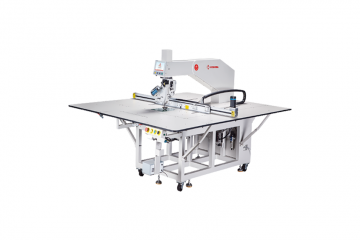
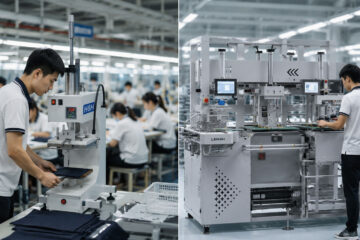
One of the most common questions when considering an SPM investment is: “How much does output actually increase in practice?” This article compiles published real-world performance data from several SPM models already applied to different operations in garment manufacturing, giving you a realistic overview before making an investment decision.
⚠️ Important note: The figures below are manufacturer-published performance data for specific machine models, measured under standard operating conditions. Actual results at your factory may vary depending on fabric type, current operator skill level, and specific operating procedures.
Performance Data Summary by Operation
| Operation | SPM | Before (manual) | After (automated) | Productivity gain |
|---|---|---|---|---|
| Zipper pre-treatment before sewing | Zipper pre-expansion machine | ~17 sec/piece | ~3–5 sec/piece | ~350% |
| Glue bonding for seamless garments | Dual-head AI vision dispensing machine | Manual, precision hard to control | Automated detection and precise glue application | ~210% |
| Chest logo/neck label pressing | 5-head heat transfer machine, dual AI inspection | ~23–28 sec/piece | ~7 sec/piece | ~300% |
| Multi-layer label joining (ultrasonic) | Ultrasonic label joining machine | ~18–25 sec/stack | Up to ~2.8 sec/stack | ~600% |
| Elastic waistbanding | Automatic elastic attaching machine | Skill-dependent, hard to keep even | ~12–15 sec/piece | Specific % not published |
| Pocket welting (jeans/trousers) | 6th-gen automatic pocket welting machine | Skill-dependent, prone to misalignment/tearing | ~20–45 sec/pocket (process-dependent) | Specific % not published |
Why Does the Productivity Gain Vary So Much Between Operations?

Looking at the table above, the multi-layer label joining operation shows the highest productivity gain (~600%), while other operations range from 210–350%. This isn’t random — three common factors determine the productivity gain from automation:
- How slow the original manual process was: manual multi-layer label joining is inherently slow (18–25 seconds) since it requires precisely stacking several thin layers by hand — when replaced by an automated ultrasonic press mechanism, processing time drops to under 3 seconds, creating a very large gap.
- The complexity of manual positioning involved: operations requiring precise positioning of multiple small components simultaneously (like stacking several label layers, or aligning a logo) tend to show higher productivity gains when automated, since the machine eliminates the “search and align” time that humans require entirely.
- The core technology applied: operations using instant-processing mechanisms (heat mold pressing, ultrasonic welding) tend to process significantly faster than operations requiring AI camera processing with a detection/calculation step before the physical action.
Key Takeaway: Which Operations Should Be Prioritized for Automation?
From the data above, three common characteristics emerge for operations that deliver the best ROI from SPM investment:
- The manual process was inherently slow or highly error-prone — the larger the performance gap between manual and automated, the faster the ROI.
- Volume is high enough to fully utilize the machine’s processing speed — a fast machine delivers limited real-world benefit if volume is too low.
- The operation directly affects finished product quality — defects at these operations (misaligned logo, wavy zipper, shifted labels) are typically the kind easily caught during buyer quality inspection.
📖 See how to apply these lessons to a specific ROI calculation for your factory in: “ROI of Investing in a Special Purpose Machine: The Cost-Payback Equation for Garment Factories”
Why Don’t Some Operations Have a Published Percentage Gain?
For operations like elastic waistbanding or pocket welting, manufacturers publish absolute processing speed (e.g., 12–15 seconds/piece) rather than a percentage gain over manual work. This is typically because manual processing time for these operations varies significantly by operator skill, making a single percentage figure a poor representation of reality across different factories. In these cases, factories should measure their own current manual processing time to compare directly against the published machine speed.
Frequently Asked Questions
Not entirely. This is data measured under the manufacturer’s standard operating conditions. Actual results at any given factory depend on fabric type, style complexity, and specific operating procedures — treat these figures as a reference point, not an absolute guarantee.
Based on published data, multi-layer label joining using ultrasonic technology currently shows the highest productivity gain (~600%), due to how exceptionally slow the original manual process was when precisely stacking several thin label layers by hand.
Measure your factory’s actual current manual processing time, then request the SPM supplier’s actual before/after performance data for the corresponding model to compare directly, rather than applying generic figures from a different operation.
Contact us in Southeast Asia - South Asia:
- Singapore: 7 Temasek Boulevard, #43-01A Suntec Tower One, Singapore 038987.
- Vietnam - Philippines - Thailand - Cambodia: Unit 1, 3rd Floor, Building H, Street 17, Tan Thuan Export & Processing Zone, Tan Thuan Ward, HCMC, Vietnam.
- India: Sy. No. 23/8, Ground Floor, Masthappa Layout, Near Yashas Vidya Kendra School, Somashettyhalli, Chikkabanavara Post, Bangalore - 560090 , Karnataka, India.
- Bangladesh: Mizan House, 6th Floor, Flat 6/A, House 6, Road 2, Lane 1, Block G, Halishahar H/E, Chattogram, Bangladesh.
- Phone: (+84) 0983 309 910 (WhatsApp, WeChat, Zalo)
- Email: marketing@hoshima-int.com
- LinkedIn | Facebook | YouTube: Hoshima International