What Is a Programmable Sewing Machine? Parts, Types & Applications for Garment Factories
20/07/2026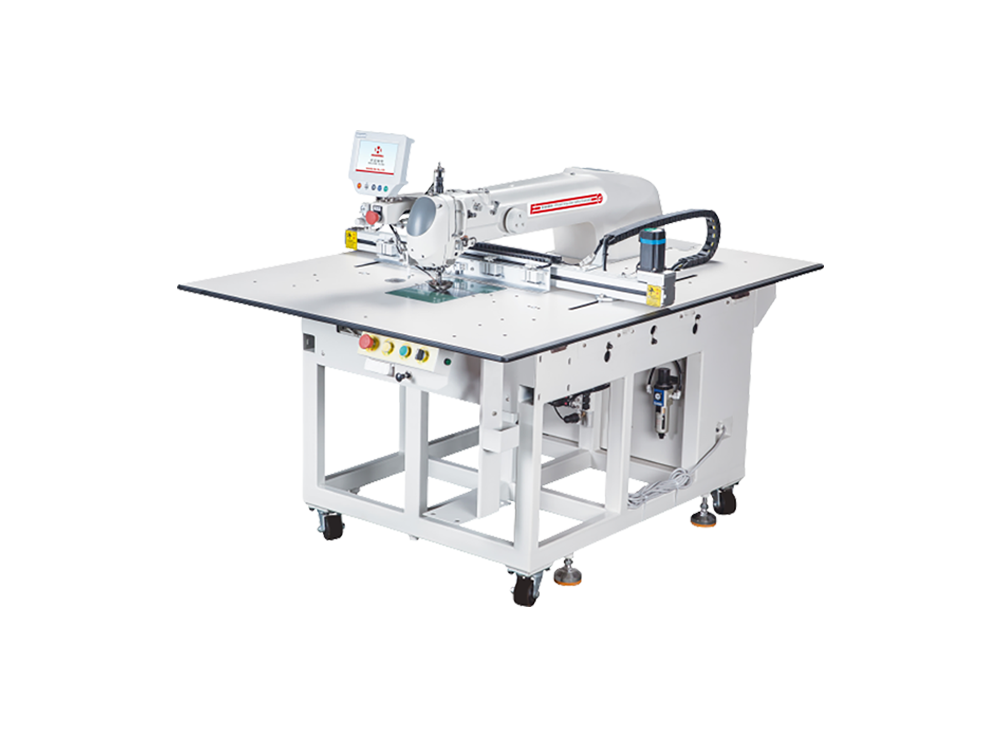
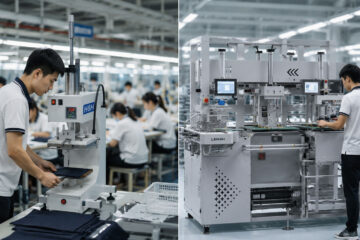
A programmable sewing machine is an industrial sewing machine built with an electronic control unit that reads and executes pre-designed stitch pattern data from dedicated design software, automatically performing the stitch line along with supporting actions such as thread trimming and presser-foot lifting — instead of relying entirely on foot-pedal control and operator skill like a traditional mechanical sewing machine. On the market today, programmable sewing machines fall into two main types: Special Purpose Machines (SPM), built for one fixed operation, and Template Sewing Machines, which use interchangeable acrylic (mica) templates to flexibly cover multiple production needs.
⚠️ Important clarification on how “programming” works: Stitch programming is not done directly on the machine through buttons or a touchscreen, as many people assume. The standard industry workflow is:
- A technician designs the stitch pattern/template using dedicated design software on a computer (similar to CAD software).
- The design is exported into a standard file format — most commonly PLT (Plot file) or DXF (Drawing Exchange Format).
- The file is loaded onto the sewing machine (via USB, LAN, or memory card) so the machine can read and execute the stitch exactly as designed.
- The on-machine screen/control panel is mainly used to select the loaded file, adjust speed and thread tension, and monitor operation — not to draw or design a complex stitch pattern from scratch.
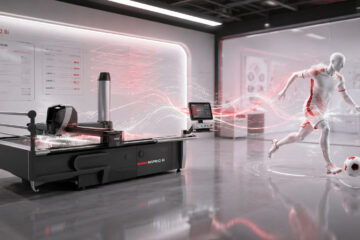
This is also why automatic fabric-cutting machines (such as Hoshima Rapido, Flatbed, TOBU) and programmable sewing machines share the same PLT/DXF file formats — allowing a single design dataset to be compatible across multiple machines within a factory’s digitized production line.
Basic Structure of a Programmable Sewing Machine
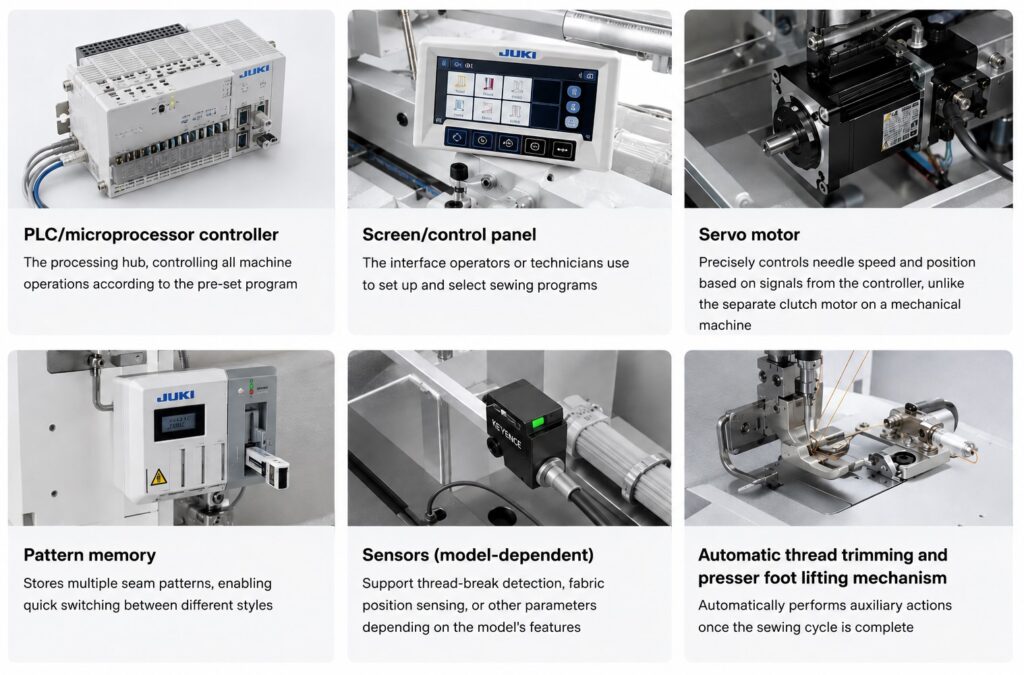
A standard programmable sewing machine (whether SPM or Template Sewing) typically includes the following components:
| Component | Function |
|---|---|
| Stitch design software (on computer) | Where a technician draws and designs the stitch pattern/template, then exports it as a PLT or DXF file — this is where the actual “programming” happens, outside the machine |
| Control unit (microprocessor) | Reads data from the loaded PLT/DXF file and converts it into motor control signals to execute the stitch — an execution role, not a design role |
| Screen/control panel | Interface for the operator to select the loaded file/program, adjust speed and thread tension, and monitor machine status |
| Servo motor | Precisely controls needle speed and position based on signals from the control unit, unlike the standalone motor on a mechanical machine |
| Storage memory | Stores loaded PLT/DXF files, allowing quick switching between programs without reloading each time |
| Sensors (model-dependent) | Support thread-break detection, fabric position detection, or other parameters depending on the model |
| Automatic thread trimming, presser-foot lifting | Performs supporting actions automatically once a stitch cycle is complete |
| Jig/template | Specific to SPM and Template Sewing: holds the fabric in the correct shape during sewing — a fixed jig for SPM, a removable acrylic template for Template Sewing |
Types of Programmable Sewing Machines
Programmable sewing machines fall into two main types, distinguished by their scope of application and how flexibly they adapt to different production steps:
- Special Purpose Machine (SPM) — specialized for one fixed operation.
- Template Sewing Machine — uses interchangeable acrylic (mica) templates to cover multiple operations/products on the same machine.
What the two types have in common
Both SPM and Template Sewing machines share the same underlying mechanism: the stitch line must be designed and programmed in advance by the technical/pattern-design team (pattern design on dedicated software, exported as a PLT/DXF file, loaded into the machine). The machine does not “draw” the stitch itself — it only executes what has already been programmed with precision. This is the core distinction from mechanical and basic electronic sewing machines.
1. Special Purpose Machine (SPM)
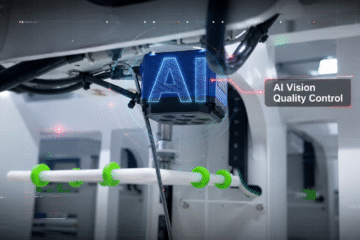
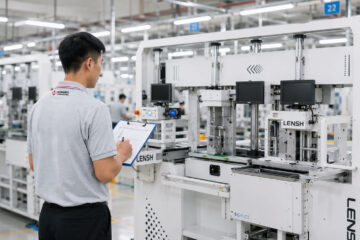
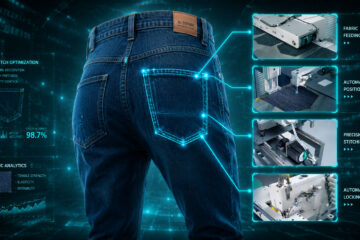
An SPM is a programmable sewing machine fitted with a fixed jig/fixture or a specialized technology (AI camera, laser, heat-press molding, ultrasonic welding, etc.) to fully automate one specific, fixed operation. The machine is designed and optimized specifically for a single task — for example, zipper attaching, belt loop attach, sewing pockets to a fixed template, or more advanced like seamless dispensing machine, or logo pressing.
Key traits:
- Fully optimized for a single operation → very high speed and precision.
- Little to no ability to switch to a different operation — the jig/fixture is usually fixed to a specific product design.
- Best suited to factories with high, stable volume on a repeated operation over a long period.
2. Template Sewing Machine
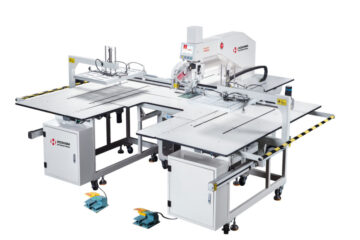
A Template Sewing Machine uses an acrylic (mica) template/jig mounted on the machine bed to hold the fabric in the exact designed shape while sewing. The needle follows the template’s outline, executing the stitch according to the programmed data. The key difference from an SPM: the acrylic template is removable and replaceable, so a single machine can serve multiple operations or product variations — operators simply swap the template and load the matching program.
Key traits:
- Flexible by order: swapping the acrylic template changes the operation/product without buying a new machine.
- A single “large” operation may actually consist of several smaller sub-steps (for example, fully sewing a pocket may involve separate steps for the pocket opening, the pocket base, and the pocket flap) — so template design must account for each individual step of the process, not just the final product shape.
- Best suited to factories running many styles, with processes that change by season or by order.
SPM vs Template Sewing Machine — Comparison Table
| Criteria | SPM (Special Purpose Machine) | Template Sewing Machine |
|---|---|---|
| Scope of application | One fixed operation | Multiple operations/products, depending on the template installed |
| Switchability | Low — jig/fixture is usually fixed | High — swap acrylic template + reload program |
| Jig/template design | Specialized fixture, fixed to one operation | Acrylic template, designed per process sub-step, replaceable |
| Best suited to | High-volume factories with stable, repeated operations | Multi-style factories with frequently changing processes |
| Example applications | Zipper attaching, bartacking, seamless taping, logo pressing | Sewing pockets in multiple styles, sewing details that vary by order |
📖 See an in-depth breakdown of this distinction in: “SPM vs Template Sewing Machine: Understanding the Two Main Types of Programmable Sewing Machines” (coming soon)
By Programming Level
Applies to both SPM and Template Sewing machines:
| Type | Characteristics |
|---|---|
| Semi-programmable | Allows setting a few basic parameters (stitch count, speed); cannot store many complex patterns |
| Fully programmable | Stores multiple detailed patterns; supports programming complex stitch lines via a touchscreen |
By Brand
The programmable sewing machine market includes multiple brands across different price segments and feature sets (Japan, Taiwan, China, etc.). Choosing the right brand depends on budget, durability requirements, and the level of local technical support available.
📖 See a detailed brand comparison in: “Comparing Popular Programmable Sewing Machine Brands” (coming soon)
How Does a Programmable Sewing Machine Differ from Mechanical and Electronic Machines?
| Criteria | Mechanical Machine | Basic Electronic Machine | Programmable Sewing Machine |
|---|---|---|---|
| Speed/stitch control | Manual (foot pedal) | Semi-automatic (direct-drive motor) | Fully automatic, based on loaded stitch data |
| Ability to load a design file (PLT/DXF) from pattern software | No | No | Yes — the core differentiator |
| Product consistency | Depends on operator skill | Fairly stable | Very stable, near-zero deviation |
| Foundation for SPM/Template Sewing | Not suitable | Limited | Suitable — a required foundation for both types |
📖 Read a deeper comparison of electronic sewing machines in: “Mechanical vs Electronic Sewing Machines: Which Should You Invest In?” 📖 See the specific distinction between electronic and programmable machines (two commonly confused terms) in: “Programmable vs Electronic Sewing Machines: Don’t Confuse These Two Concepts”
Real-World Applications
- Sewing operations that require high precision and consistency across thousands of repeats — for example, body-joining seams or edge stitching that must stay uniform across a large production run.
- Faster training for new operators, since dependence on traditional pedal-driven sewing skill is reduced.
- For SPM: full automation of one fixed operation, maximizing throughput for high-volume, stable operations.
- For Template Sewing: flexible handling of multi-step processes — for example, a large operation like finishing a pocket may be split into several smaller steps (sewing the opening, the base, the flap), each using its own acrylic template — helping a factory handle many styles without investing in multiple dedicated machines.
When Should a Factory Invest In or Upgrade To a Programmable Sewing Machine?
Not every factory needs to invest right away. Consider it if:
- Orders are high-volume and repetitive with the same stitch type — the investment pays back quickly through time saved per unit. (Fits an SPM investment path)
- Customers demand consistently high stitch quality, particularly for export orders to major brands.
- The factory struggles to hire highly skilled operators — a programmable machine lowers the skill barrier.
- The factory runs many styles with processes that change by season or order — consider a Template Sewing investment to take advantage of flexible template swapping instead of buying multiple dedicated SPMs.
Conversely, if a factory mainly handles small, highly varied orders with constantly changing styles and cannot reach the volume needed to justify even a swappable template setup, the investment may not pay off in the short term.
📖 See a detailed cost analysis in: “The Real Cost of a Programmable Sewing Machine: Is It Worth It vs a Mechanical Machine?”
How Programmable Sewing Machines, SPM, and Template Sewing Relate
The programmable sewing machine is the essential technical foundation behind both specialized machine types: SPM and Template Sewing. Both share the same core mechanism — reading and executing a stitch design file (PLT/DXF) — but branch into two different specialization paths:
- The SPM path: adding a fixed jig/fixture or specialized technology (AI camera, laser, heat-press molding, ultrasonic welding, etc.) permanently for one operation — optimized for throughput, not for switching.
- The Template Sewing path: adding a removable, replaceable acrylic template — keeping precise execution while staying flexible across multiple operations/products.
📖 Read more on this relationship in: Template Sewing Machine: What It Is and How It Actually Works 📖 Explore SPMs in depth in the pillar article: “What Is a Special Purpose Sewing Machine (SPM)? An Automation Solution for Every Garment Production Step”
Frequently Asked Questions
A basic electronic sewing machine only has a direct-drive motor and a few automated functions (such as thread trimming); it cannot load an external stitch design file. A programmable sewing machine can read and execute a PLT/DXF file created in dedicated pattern-design software, enabling complex, customized stitch lines that a basic electronic machine cannot produce.
Both are programmable sewing machines that require the stitch line to be designed in advance by a technical team. The key difference is switchability: an SPM uses a fixed jig/fixture dedicated to one operation, while a Template Sewing machine uses a removable acrylic template, allowing a single machine to handle multiple operations or product variations.
No. The stitch is designed in dedicated software on a computer (similar to CAD), then exported as a PLT or DXF file and loaded onto the machine via USB or a network connection. The on-machine screen is only used to select the loaded file and adjust operating parameters (speed, thread tension) — not to draw the stitch from scratch.
The upfront investment is usually higher due to the added electronic control unit capable of reading design files. However, this cost is typically offset over time through faster production and a lower defect rate.
If your factory has a high-volume, stable, long-running operation, an SPM typically delivers better throughput. If your factory produces many styles with processes that change by season or by order, a Template Sewing machine offers more flexibility through swappable acrylic templates, without the need to invest in additional machines.
Contact us in Southeast Asia - South Asia:
- Singapore: 7 Temasek Boulevard, #43-01A Suntec Tower One, Singapore 038987.
- Vietnam - Philippines - Thailand - Cambodia: Unit 1, 3rd Floor, Building H, Street 17, Tan Thuan Export & Processing Zone, Tan Thuan Ward, HCMC, Vietnam.
- India: Sy. No. 23/8, Ground Floor, Masthappa Layout, Near Yashas Vidya Kendra School, Somashettyhalli, Chikkabanavara Post, Bangalore - 560090 , Karnataka, India.
- Bangladesh: Mizan House, 6th Floor, Flat 6/A, House 6, Road 2, Lane 1, Block G, Halishahar H/E, Chattogram, Bangladesh.
- Phone: (+84) 0983 309 910 (WhatsApp, WeChat, Zalo)
- Email: marketing@hoshima-int.com
- LinkedIn | Facebook | YouTube: Hoshima International