SPM vs Template Sewing Machine: The Two Main Types of Programmable Sewing Machines, Explained
20/08/2026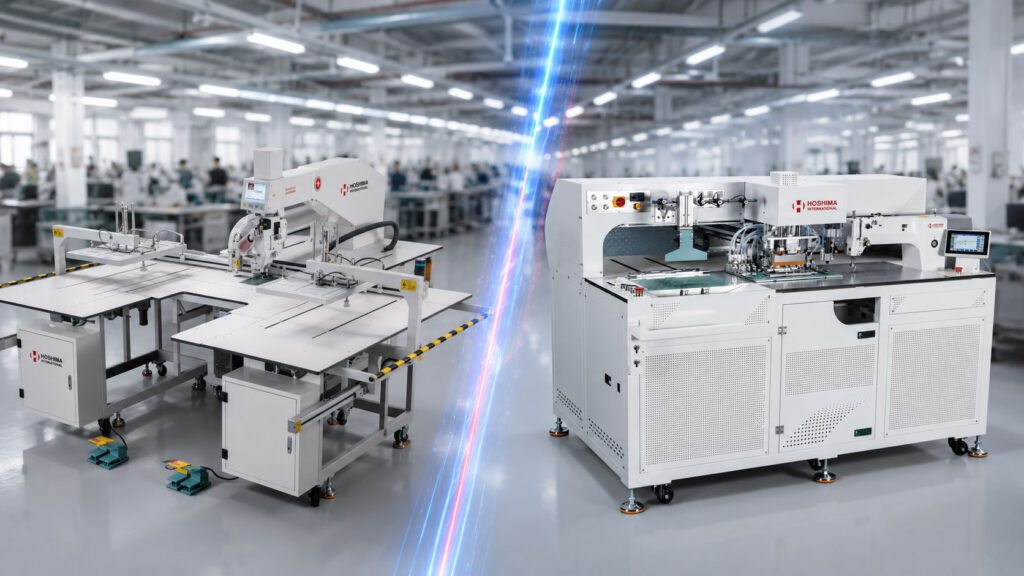
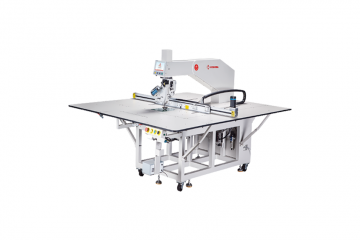
SPM (Special Purpose Machine) and Template Sewing Machine are both specialized types built on the programmable sewing machine foundation, sharing the same core mechanism of reading a pre-programmed PLT/DXF design file. The core difference lies in the ability to switch between operations: an SPM uses a fixed jig/fixture, deeply specialized for one single operation; a Template Sewing machine uses a removable/replaceable acrylic template, allowing one machine to handle multiple operations or multiple sewing details within the same product.
Detailed Comparison: SPM vs Template Sewing Machine
| Criteria | SPM (Special Purpose Machine) | Template Sewing (Multi-Purpose Machine) |
|---|---|---|
| Scope of application | One fixed operation, for the machine’s entire lifespan | Multiple operations/details, depending on the template installed |
| Fabric-positioning mechanism | Specialized jig/fixture, fixed design for one action | Acrylic template (may include a base template + auxiliary templates), positioning fabric for each small step of the process |
| Ability to switch operations | Low — essentially cannot switch to a different operation | High — swap auxiliary templates/jig + reload the matching program |
| Changeover time between different-style batches | Not applicable (the machine only does one task) | A few minutes to tens of minutes depending on jig complexity and the number of layers to swap |
| Initial jig/template cost | One-time, matched to a single fixed operation | Base template is a one-time investment; auxiliary templates recur with each new detail/operation |
| Jig design complexity | Moderate — focused on one single action | Higher — must account for multiple layers/steps, requiring tight coordination between the design file and the jig mechanism |
| Staffing required | Low ongoing need — designed once, runs stably long-term | Requires a jig-design team + program-loading technicians working more regularly |
| Production speed per operation | Very high — deeply optimized | High, but usually slightly lower than SPM due to time spent opening/closing or swapping templates |
| Investment risk if orders/operations change | High — the jig cannot be reused for a different task | Lower — the machine and base template remain usable; only a new auxiliary template is needed |
| Best suited for | Factories with a high-volume, long-term stable operation (≥12–18 months) | Factories running many styles, with varied sewing details and processes that shift by season/order |
| Common example applications | Zipper attaching, bartacking, seamless taping, logo pressing | Sewing a shirt collar, finishing a pocket, and other sewing details with several small steps in the same product |
Real-World Examples by Machine Type
SPM Application Examples
- Automatic zipper attaching: the machine is deeply optimized to position and sew a zipper in the exact spot, at high speed, repeated thousands of times with near-zero deviation.
- Bartacking: reinforces stress points (pocket corners, straps) — a purely repetitive action that doesn’t need to change by style.
- Seamless taping / logo pressing: integrates specialized heat or ultrasonic technology for one fixed material/position on the product.
Template Sewing Application Examples
- Sewing a shirt collar (covered in detail in “Stitch Design Process & PLT/DXF File Export”): the process includes several small steps — laser-cutting the two outer collar panels, placing the interlining, sewing the three edges — each step corresponding to a different template layer.
- Finishing a pocket: a more detailed illustrative example follows below.
Illustrative Example: Finishing a Pocket on a Template Sewing Machine
📌 Note on this example: this is a conceptual illustration meant to show how one large operation can be broken into several smaller steps on a Template Sewing machine. The actual jig mechanism can vary by supplier and by product — confirm the specifics with your technical team or jig manufacturer before applying this to real production.
Finishing a pocket is a large operation typically broken into 3 smaller steps: sewing the pocket opening → sewing the pocket base → sewing the pocket flap. In terms of jig structure, a common approach looks like this:
- Base template: holds the overall shape of the pocket and positions the fabric throughout all 3 steps, staying in place for the entire operation without being removed.
- Auxiliary template per step: each step (opening/base/flap) may involve different sewing details, so a separate auxiliary template is used for each — this can be magnet-mounted, or hinged (opening and closing like a small window) directly on the base template — with its main function being to additionally secure the fabric/detail needed for that specific step, rather than replacing the base template’s overall positioning role.
- Magnets on both sides: magnets are built into both the base template and the auxiliary template, helping the auxiliary template lock into the correct position with enough holding force during sewing.
- Switching between steps: when moving from one step to the next, the factory doesn’t necessarily need to fully remove the previous step’s auxiliary template — a new auxiliary template can be placed directly over it (held by magnetic force) instead of a full removal, shortening the changeover time between steps within the same operation.
- Matching design file: each small step still needs its own PLT/DXF file loaded onto the machine, precisely matching the position and shape of the auxiliary template in use — even a small mismatch between the design file and the actual jig can cause the stitch to land in the wrong position.
This approach illustrates why jig design for Template Sewing requires tight coordination between the stitch-design team (software) and the jig-fabrication team (tooling) — unlike SPM, where the jig/fixture only needs to be designed once for one fixed action.
Selection Criteria: Should You Invest in SPM or Template Sewing?
Rather than deciding on instinct, a factory should answer the following questions first:
| Question to answer | Leans toward SPM if… | Leans toward Template Sewing if… |
|---|---|---|
| Will this operation stay stable for the next 12–18 months? | Yes, volume and style are essentially unchanged | No, the operation/detail changes by season or by order |
| Is the volume for this operation large enough to justify optimization? | Very high volume, concentrated on one action | Moderate/small volume, but spread across many different styles |
| Does the factory have a jig-design team working regularly? | Not needed — the jig is designed once | Needed — auxiliary templates keep coming up with each new style |
| Can the budget absorb the risk of a “stranded” jig if orders change? | Yes, the factory has committed to this operation long-term | No, flexibility is needed to avoid over-investment risk |
| Does the factory plan to automate multiple different products/details? | No, focused on just one operation | Yes, wants one machine to serve varied needs over time |
Quick guide: if most of your factory’s answers fall in the SPM column, prioritize SPM for that operation to maximize speed and minimize cost per unit. If most answers fall in the Template Sewing column, prioritize Template Sewing to reduce the risk of over-investment as the product mix changes.
When you don’t have to choose just one: many large factories run both types in parallel — SPM for extremely high-volume, stable operations (e.g., zipper attaching across the entire line), and Template Sewing for operations with varied sewing details that change by style (e.g., finishing pockets, collars).
Frequently Asked Questions
Technically, Template Sewing can be used for most operations, but for extremely high-volume, long-term stable operations, SPM usually still delivers better cost per unit thanks to being deeply optimized for one single action.
It does add time for opening/closing or swapping auxiliary templates between steps, but with a well-designed jig mechanism (e.g., using magnets or hinges instead of full removal), changeover time can be significantly shorter than swapping the entire template.
It depends on scale: smaller factories can outsource jig fabrication per order as needed; larger factories with frequent style changes should consider building an in-house jig-design team to shorten preparation time for each new order.
Contact us in Southeast Asia - South Asia:
- Singapore: 7 Temasek Boulevard, #43-01A Suntec Tower One, Singapore 038987.
- Vietnam - Philippines - Thailand - Cambodia: Unit 1, 3rd Floor, Building H, Street 17, Tan Thuan Export & Processing Zone, Tan Thuan Ward, HCMC, Vietnam.
- India: Sy. No. 23/8, Ground Floor, Masthappa Layout, Near Yashas Vidya Kendra School, Somashettyhalli, Chikkabanavara Post, Bangalore - 560090 , Karnataka, India.
- Bangladesh: Mizan House, 6th Floor, Flat 6/A, House 6, Road 2, Lane 1, Block G, Halishahar H/E, Chattogram, Bangladesh.
- Phone: (+84) 0983 309 910 (WhatsApp, WeChat, Zalo)
- Email: marketing@hoshima-int.com
- LinkedIn | Facebook | YouTube: Hoshima International