Ways To Automatic Jeans Pockets Sewing | 60% Reduce Production Time
03/06/2026
In denim garment production, the pocket block—comprising the front pockets, back pockets, and the coin pocket—is considered the “heart” that defines the aesthetic value and brand identity of the jeans. However, from an Industrial Engineering (IE) perspective, this zone represents the highest risk for Work in Progress (WIP) accumulation on the floor. Relying on manual iron-folding and visual alignment by operators makes the assembly line’s throughput highly unstable. To solve this bottleneck, modern apparel exporters in major manufacturing hubs like India, Bangladesh, and Indonesia are swiftly transitioning to a synchronized, fully automatic jeans pocket sewing machine workflow.
1. The Pocket Block Bottleneck: An Industrial Engineer’s Perspective
On a traditional sewing line, an operator manually attaching a back pocket must execute multiple steps: receive the semi-finished panel, place it on an ironing station to pre-fold the pocket edges, move it to a standard single-needle lockstitch machine, align the folded pocket onto the back yoke by eye, and finally stitch it down.
Under time-motion studies, the time an operator spends handling, smoothing, and aligning the fabric (Handling Time) accounts for a staggering 70% of the cycle, while the actual sewing time (Machine Time) is a mere 30%.
The Line-Balancing Consequence: If a single operation within the pocket block lags behind the target Takt Time, it triggers a domino effect. The downstream operations—such as outseam joining, inseam tracking, and waistband attaching—will face severe idle time, driving up factory overhead costs and crippling overall efficiency.
2. Modern Denim Pocket Assembly Line: 3 HOSHIMA Automation Solutions
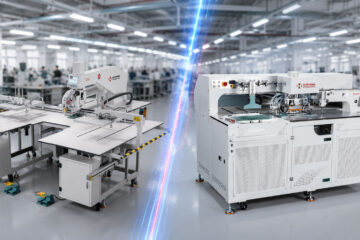
To maximize efficiency, HOSHIMA introduces an end-to-end automated ecosystem designed to streamline the entire pocket block value chain:
[Pocket Mouth Hemming: HSM-521/APH] ➔ [Back Pocket Setting: HSM-821/APA] & [Coin Pocket Attaching: HSM-721-ACP]
Step 1: Automatic Jeans Pocket Mouth Hemming
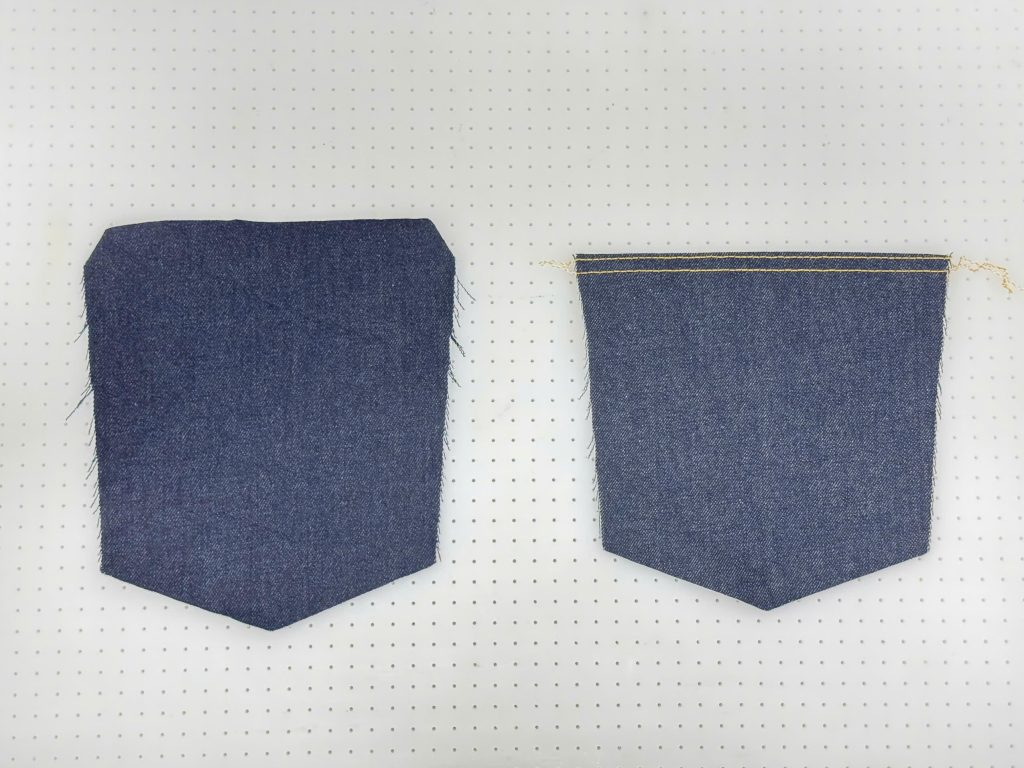
Jeans back pocket before and after hemming process
Before pockets can be attached to the panels, their top openings must be hemmed to prevent fraying. The Automatic Pocket Hemming Machine | HSM-521/APH completely bypasses the need for separate manual folding or pressing.
-
Operation: The operator simply drops the fabric panel into the feeding slot. An automated folder binder mechanism handles the thick denim material, while high-precision sensors trigger the 2-needle chainstitch sewing head.
-
IE Efficiency: Delivers a production rate three times faster than conventional sewing, producing perfectly flat, wave-free pocket hems.
Step 2: Automatic Jeans Pocket Setter
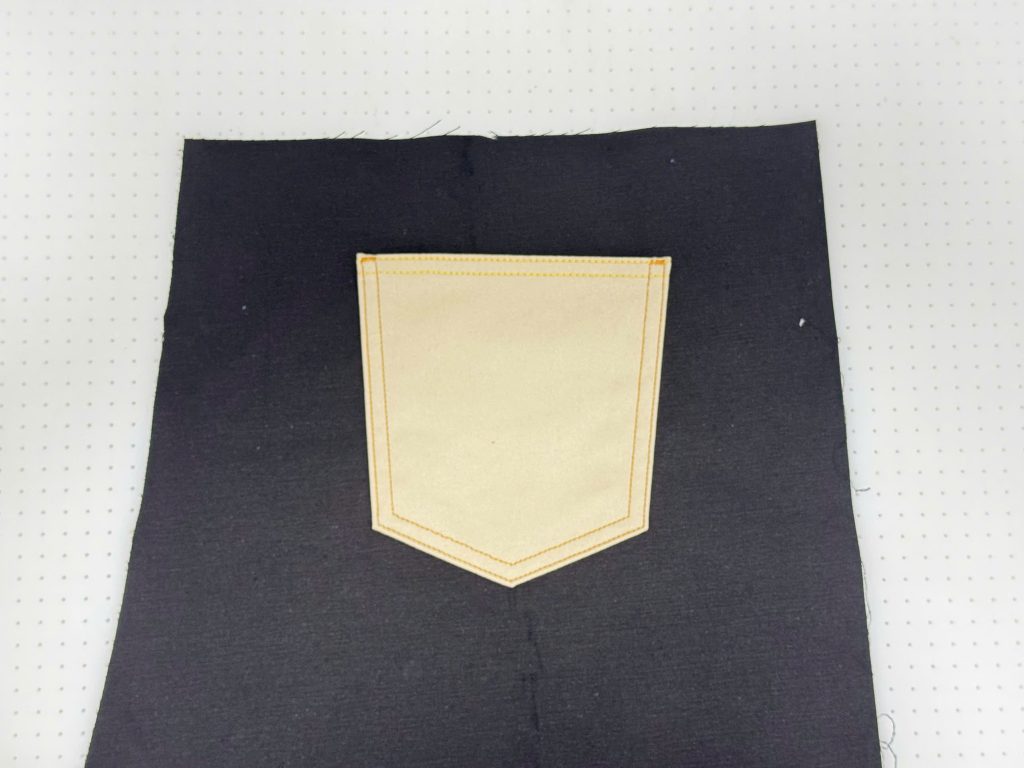
Jean pocket setting to the cut panel after hemmed
This is the final station of the back pocket block. The Automatic Jeans Pocket Sewing Machine HSM-821/APA is a fully computerized programmable pocket attaching system.
-
Operation: This machine performs two critical operations simultaneously within a single machine cycle: it iron-presses and folds the raw pocket edges, and then topstitches the pocket symmetrically onto the back panel.
-
IE Efficiency: Replaces 2 to 3 skilled manual workers. It produces perfectly parallel, double-line topstitching, entirely eliminating the risk of mismatched or asymmetrical pocket placements between the left and right panels.
Step 3: Automatic Coin Pocket Sewing Machine
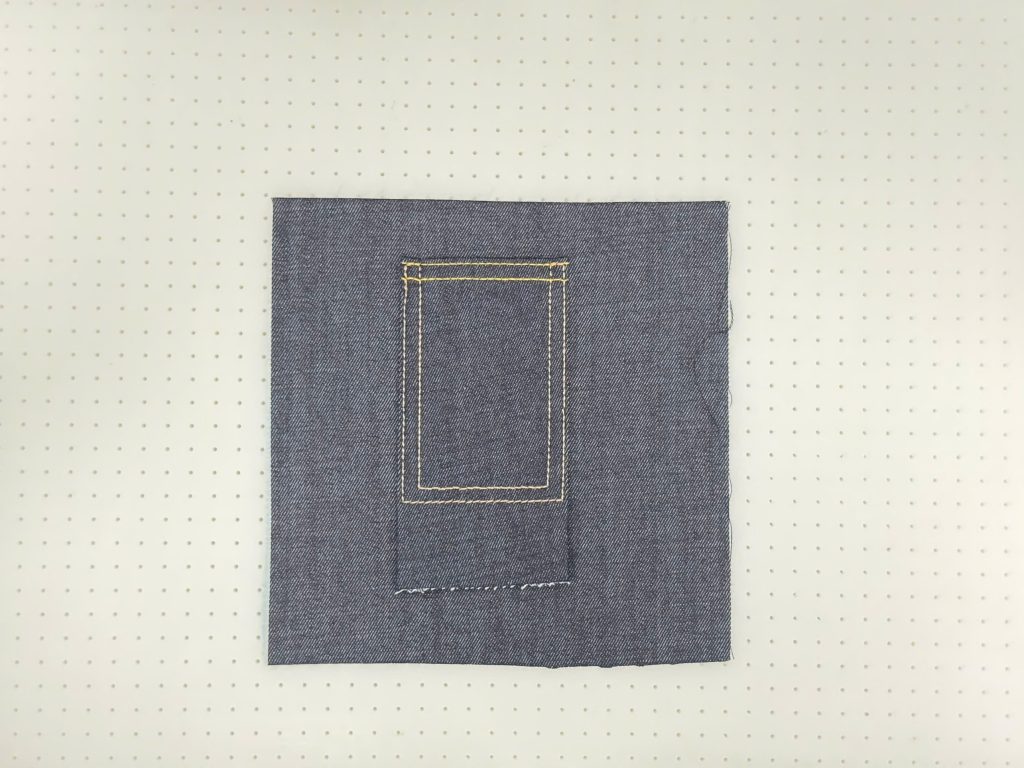
Automatic coin pocket sewing machine result
Due to its tiny size, the coin pocket (or watch pocket) is notoriously difficult for operators to hold, manipulate, and topstitch onto the front pocket lining. The Automatic Coin Pocket (Watch Pocket) Setter Machine | HSM-721-ACP is engineered specifically to eliminate this pain point.
-
Operation: The machine utilizes an automated pneumatic die clamp to fold all four sides of the coin pocket instantly. A robotic transfer arm then shifts the folded pocket into the programmable field to stitch it directly onto the front lining.
-
IE Efficiency: Lowers the required operator skill level from Grade A/B down to an entry-level worker. Anyone can consistently produce millimeter-accurate coin pocket attachments.
3. Industrial Manufacturing QA (People Also Ask)
How to prevent seam puckering when sewing thick denim pockets?
Answer: Seam puckering on heavy denim (12–14 oz) typically stems from uneven thread tension and ply shifting caused by standard drop-feed feed dogs. HOSHIMA’s automatic sewing machines utilize a heavy-duty pneumatic outer clamp that secures the fabric completely flat. Combined with an intermittent pulse-motor driven XY feed system, it guarantees zero fabric slippage and eliminates puckering entirely.
How does an automatic jeans back pocket setter machine work?
Answer: The machine operates by integrating precise mechanical automation with computerized programming. Internal mechanical folding blades use pneumatic pressure to neatly tuck and crease the pocket margins. Next, a customized clamp takes hold of the folded pocket and moves it dynamically along a pre-programmed XY coordinate track beneath the sewing head, completing the stitch pattern flawlessly without human intervention.
Conclusion
By synchronizing the pocket section with HOSHIMA’s automatic jeans pocket sewing machine series, garment manufacturing plants can reclaim valuable floor space by reducing accumulated WIP. More importantly, it empowers factories in India, Bangladesh, and Indonesia to confidently guarantee absolute quality consistency, helping them secure high-volume, premium export orders for global Western brands.
Contact us for a consultation or to schedule a machine demo at our showroom:
-
Phone: (+84) 0983 309 910 (WhatsApp, WeChat, Zalo)
-
Email: marketing@hoshima-int.com
-
LinkedIn | Facebook | YouTube: Hoshima International
Hoshima specializes in automation solutions for the garment industry, offering:
- Smart Warehousing
- Fabric Defect and Color Inspection
- Automated Cutting Line
- Sewing Technology
- Sub-process/ PPA Automation
- Finishing Technology
- Smart Logistic