Industrial Sewing Machine Investment Cost for Small & Mid-Sized Garment Factories (2026)
28/07/2026
The cost of investing in industrial sewing machines goes well beyond the upfront purchase price. For accurate financial planning, a garment factory needs to account for the Total Cost of Ownership (TCO) — covering purchase cost, operating costs, maintenance, and training across the machine’s full working life.
⚠️ Important note: This article provides a general cost-analysis framework for reference purposes. Actual industrial sewing machine prices vary continuously by brand, supplier, market timing, and currency fluctuation. Please contact suppliers directly for an accurate, up-to-date quotation tailored to your factory’s specific needs.
Factors That Affect Investment Cost
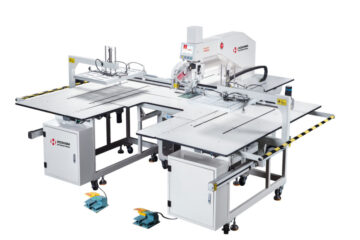
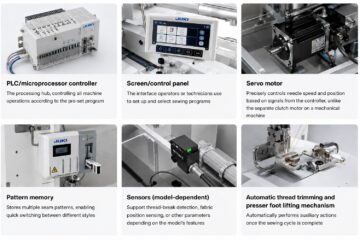
- Machine type (mechanical/electronic/programmable/SPM): mechanical machines have the lowest cost, rising through electronic and programmable machines, with Special Purpose Machines (SPM) at the top due to their integrated jig/fixture/template systems or AI technology.
- Origin and brand: machines imported from established brands (Japan, Germany, or specialized manufacturers) typically cost more than domestically assembled machines, but come with better durability and precision.
- Number of machines needed: bulk purchases usually come with better discounts, but require a larger upfront capital outlay.
- Included features: features like AI recognition, remote data collection, and automatic material collection increase cost compared to standard machines.
- Shipping, installation, and initial operator training costs: particularly important for imported or specialized machines that require dedicated technical training.
Total Cost of Ownership (TCO) Structure to Account For
| Cost item | Description |
|---|---|
| Machine purchase cost | Upfront price, which may be paid in full or financed depending on the supplier’s terms |
| Shipping & installation | Especially relevant for large imported machines, requiring domestic freight and on-site installation costs |
| Operating power cost | Mechanical machines draw power continuously via clutch motors; electronic/programmable machines are more energy-efficient with direct-drive motors |
| Routine maintenance cost | Includes oil, needles, wear parts — factor in an annual maintenance budget |
| Operator training cost | Especially relevant for electronic/programmable/SPM machines, requiring training time for correct operating procedures |
| Unplanned repair cost | For electronic machines, circuit repair costs when faults occur are typically higher than for mechanical machines |
Cost Framework by Machine Type (for reference only)
| Machine type | Relative investment level | Notes |
|---|---|---|
| Single-needle mechanical machine | Lowest of all types | Suited to limited budgets, newly established factories |
| Single-needle electronic machine | Moderate, typically 30–70% higher than mechanical | Energy savings, higher long-term speed |
| Double-needle machine | Higher than single-needle machines in the same tier | Due to more complex construction (two needles, two bobbin systems) |
| Special Purpose Machine (e.g., zipper pre-treatment, AI glue dispensing, automatic heat transfer) | Highest in the group | Offset by significant productivity gains (typically 200–350% vs. manual methods) for that specific operation |
How to Calculate Payback Period (ROI) for a Specialized Machine
For SPMs with higher upfront investment, a simple payback-period estimation formula is:
Payback period (months) = Machine investment cost / (Monthly labor cost savings + Monthly value of increased output)Illustrative example (conceptual only, not actual figures): if an operation currently takes 25 seconds per piece manually, and an SPM reduces that to 7 seconds per piece (similar to the performance data seen with some current SPM models), a factory can calculate the additional pieces produced per shift, then convert that into an incremental output value to compare against the upfront investment cost.
📌 For an accurate ROI figure specific to your factory, request actual before/after performance data for the specific machine model from your supplier, and combine it with your factory’s current production volume and labor cost per piece.
Budget Guidance by Factory Scale
- Small factories (under 50 machines): prioritize single-needle mechanical/electronic machines as the foundation, investing in an SPM for only 1–2 of the highest-volume operations to avoid spreading capital too thin.
- Mid-sized factories (50–200 machines): can allocate a higher proportion of electronic/programmable machines for core operations, while investing in a few SPMs for operations that commonly cause defects or consume excessive labor.
- Large export-oriented factories: should build a phased investment roadmap, prioritizing SPM investment for operations that directly affect quality standards required by international buyers.
Frequently Asked Questions
Low-cost machines may suit a limited initial budget, but factories should weigh the risk of reduced durability, higher unplanned repair costs, and whether the machine can meet quality standards if the factory targets export orders. Evaluate based on Total Cost of Ownership (TCO) rather than upfront price alone.
SPMs deliver the best returns when the target operation has sufficient volume to offset the investment cost. Small factories should carefully assess the expected volume of the operation before deciding, and may start with the operation showing the highest defect rate to test the results.
Whether to finance or pay in full depends on each company’s cash flow and financial plan — this is a company-specific financial decision that should be discussed with your finance/accounting team or a financial advisor before deciding.
Contact us in Southeast Asia - South Asia:
- Singapore: 7 Temasek Boulevard, #43-01A Suntec Tower One, Singapore 038987.
- Vietnam - Philippines - Thailand - Cambodia: Unit 1, 3rd Floor, Building H, Street 17, Tan Thuan Export & Processing Zone, Tan Thuan Ward, HCMC, Vietnam.
- India: Sy. No. 23/8, Ground Floor, Masthappa Layout, Near Yashas Vidya Kendra School, Somashettyhalli, Chikkabanavara Post, Bangalore - 560090 , Karnataka, India.
- Bangladesh: Mizan House, 6th Floor, Flat 6/A, House 6, Road 2, Lane 1, Block G, Halishahar H/E, Chattogram, Bangladesh.
- Phone: (+84) 0983 309 910 (WhatsApp, WeChat, Zalo)
- Email: marketing@hoshima-int.com
- LinkedIn | Facebook | YouTube: Hoshima International