Why Should Garment Factories Invest in Special Purpose Machines Instead of Relying Solely on Manual Labor?
04/08/2026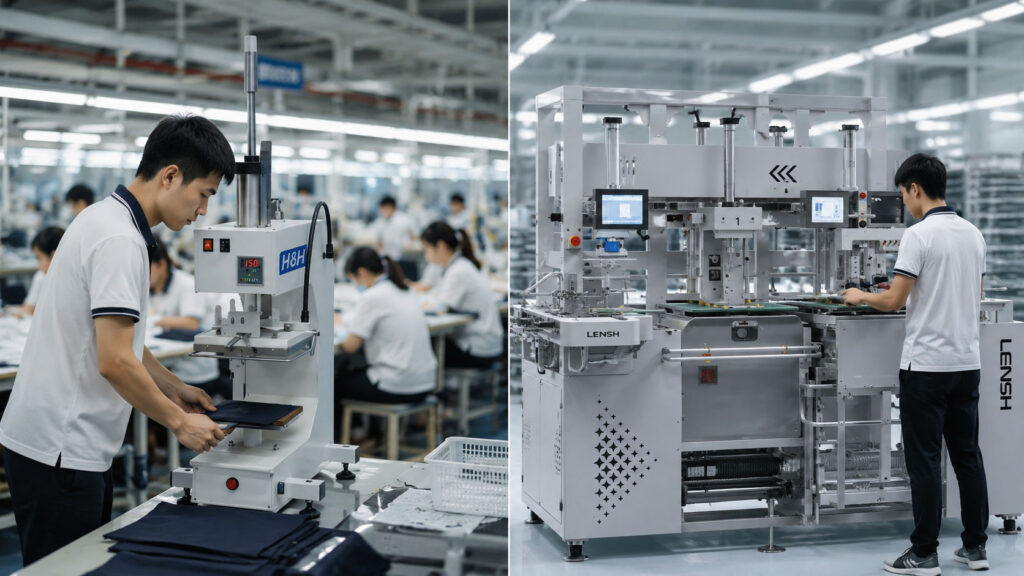
The garment industry has always depended heavily on skilled labor, but the landscape is changing quickly: labor costs rise steadily year after year, skilled workers are increasingly difficult to hire, and international buyers demand ever-stricter quality standards. This is exactly why more factories are shifting toward investing in Special Purpose Machines (SPM) for specific operations, rather than relying entirely on manual labor.
1. Labor Costs Rise Steadily Over Time; Machine Cost Is a One-Time Investment
Labor costs in the garment industry tend to rise year over year due to minimum wage adjustments, insurance, and benefits. This is a variable cost that increases continuously, with no ceiling. In contrast, investing in an SPM is largely a one-time investment at the time of purchase, with only ongoing operating and maintenance costs — typically far lower than the cumulative labor cost increases compounding over several years.
2. Skilled Labor Shortage and High Turnover
The garment industry faces persistent difficulty hiring and retaining skilled labor, particularly for operations requiring specialized skill such as precise zipper attaching, accurate logo pressing, or glue bonding on seamless products. SPMs directly address this problem, since most models are designed to require no skilled workers — newly trained operators can run them effectively after just a short training period.
3. Consistent Quality, Not Dependent on Shift-to-Shift Operator Performance
With manual labor, seam quality, logo positioning accuracy, or glue-line evenness all depend on operator skill and focus at any given moment — which can fluctuate between morning and night shifts, or between the start and end of the week. An SPM maintains consistent precision throughout operation, unaffected by human factors, significantly reducing defect rates across production batches.
4. Output Isn’t Limited by Manual Handling Speed
When an urgent order requires a rapid increase in output, manual labor hits a natural ceiling — even with overtime, output per worker is difficult to push beyond a certain threshold. SPMs break through this limitation. Based on real-world data from some current SPM models:
| Operation | Before (manual) | After (SPM) | Productivity gain |
|---|---|---|---|
| Logo/label pressing (5-head automatic heat transfer machine) | ~23–28 sec/piece | ~7 sec/piece | ~300% |
| Seamless glue bonding (AI vision dispensing machine) | Manual, precision uncontrolled | Automated detection, precise glue application | ~210% |
5. Meeting Strict Quality Standards from International Buyers
For export orders to major international brands, quality control (QC) standards are increasingly strict — even minor logo misalignment or uneven seams can result in an entire shipment being rejected. SPMs with automated inspection mechanisms (such as AI camera checks before/after processing) help factories meet these standards consistently, reducing the risk of returned shipments or rework requests.
So Should a Factory Automate Everything?
Not necessarily. SPMs deliver the best results when applied to the right operations — specifically ones that:
- Have sufficient, repetitive volume to offset the investment cost.
- Are prone to defects when done manually (zipper attaching, seamless glue bonding, logo pressing).
- Require high, consistent precision that manual skill struggles to sustain reliably over time.
For operations requiring high flexibility, frequently changing styles, or low production volume, manual labor remains the cost-effective choice. The question isn’t “replace people entirely with machines” — it’s about identifying the right operations to invest SPM into to optimize both cost and quality.
📖 Learn how to calculate payback period for SPM investment in: “ROI of Investing in a Special Purpose Machine: The Cost-Payback Equation for Garment Factories”
Frequently Asked Questions
No. An SPM specializes in a single, specific operation and does not replace the entire production process. Factories still need manual labor for other operations, especially those requiring high flexibility or low production volume.
For operations with sufficient volume, SPM investment cost is typically recovered within a reasonable timeframe through labor cost savings and reduced defect rates — this should be calculated based on your factory’s actual production volume and current labor cost.
Prioritize the operation with the highest defect rate or the highest labor cost when done manually — these are typically the operations that deliver the fastest ROI when converted to an SPM.
Contact us in Southeast Asia - South Asia:
- Singapore: 7 Temasek Boulevard, #43-01A Suntec Tower One, Singapore 038987.
- Vietnam - Philippines - Thailand - Cambodia: Unit 1, 3rd Floor, Building H, Street 17, Tan Thuan Export & Processing Zone, Tan Thuan Ward, HCMC, Vietnam.
- India: Sy. No. 23/8, Ground Floor, Masthappa Layout, Near Yashas Vidya Kendra School, Somashettyhalli, Chikkabanavara Post, Bangalore - 560090 , Karnataka, India.
- Bangladesh: Mizan House, 6th Floor, Flat 6/A, House 6, Road 2, Lane 1, Block G, Halishahar H/E, Chattogram, Bangladesh.
- Phone: (+84) 0983 309 910 (WhatsApp, WeChat, Zalo)
- Email: marketing@hoshima-int.com
- LinkedIn | Facebook | YouTube: Hoshima International