Programmable vs. Electronic Sewing Machine: Don’t Confuse These Two Terms
14/08/2026
In the market, many buyers confuse “electronic sewing machine” with “programmable sewing machine” — and some sellers use these two terms interchangeably during consultations. This confusion can lead a factory to pay for a feature it assumes exists but actually doesn’t, or conversely, miss out on the machine actually needed for its long-term automation plans.
Why Are These Two Terms So Often Confused?
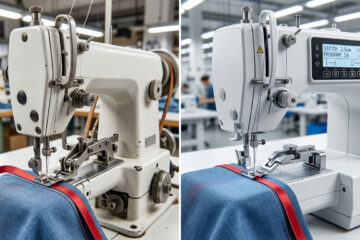
Both “electronic sewing machine” and “programmable sewing machine” share one thing in common versus a mechanical machine: they integrate electronic components, a direct-drive motor, and a few automated features. Because of this shared trait, many people default to assuming “electronic = programmable,” when in reality these are two different technology tiers, not one and the same.
Clear Distinction: How Is an Electronic Machine Different from a Programmable One?
| Criteria | Basic electronic sewing machine | Programmable sewing machine |
|---|---|---|
| Controller | Only a simple motor control circuit | Full PLC/microprocessor controller |
| Storing seam programs (patterns) | No, or very limited (1–2 fixed settings) | Yes, stores multiple detailed patterns |
| Control screen | Usually none, or just simple buttons | Has a screen/control panel for programming and pattern selection |
| Automatic thread trimming | Yes (common feature on both types) | Yes |
| Ability to customize complex seams | No | Yes, can program a custom seam shape |
| Price point | Lower than programmable machines | Higher, reflecting added features |
How to Verify When Buying: Which Specs Should You Check?
When talking to a supplier or reviewing technical specs, here’s what to ask to avoid confusion:
- How many patterns/seam programs can the machine store? — If the answer is “none” or “only 1–2 fixed settings,” this is a basic electronic machine, not a programmable one.
- Does the machine have a screen/control panel for programming seams? — Programmable machines always have this interface; basic electronic machines usually only have simple switches/buttons.
- What type of motor does it use? — Both types commonly use a direct-drive (servo) motor, so this detail alone isn’t enough to distinguish them — this is actually the biggest source of confusion.
- Does the machine support adding a jig/fixture/template system to upgrade it into an SPM? — Only a programmable machine has the technical foundation suitable for this.
Why Does This Confusion Matter for Your Investment Decision?
If your factory plans to develop toward Special Purpose Machines (SPM) in the future — such as a zipper attaching machine, an AI glue dispensing machine, or an automatic logo pressing machine — you must invest in the correct programmable machine from the start; a basic electronic machine cannot serve as the foundation. Mistakenly buying an electronic machine thinking it’s programmable means the factory will have to reinvest from scratch when it’s time to upgrade to an SPM later — a significant waste of cost.
📖 See the full breakdown of the relationship between programmable machines and SPMs in: “Programmable Sewing Machines Are the Foundation of Special Purpose Machines: What You Need to Know”
Frequently Asked Questions
Not necessarily. Both basic electronic machines and programmable machines can use a direct-drive motor — this is the most common source of confusion. The deciding factor is whether the machine has a PLC/microprocessor controller and the ability to store multiple patterns, not the motor type.
Typically, the software/hardware of a basic electronic machine cannot be upgraded into a full programmable machine, since it lacks the necessary PLC controller and program memory. Factories need to invest in a new programmable machine if they want these full features.
Request clear technical specifications on the controller (PLC/microprocessor) and the number of storable patterns from the supplier, and ask to see the seam-programming screen/control panel directly before deciding to purchase.
Contact us in Southeast Asia - South Asia:
- Singapore: 7 Temasek Boulevard, #43-01A Suntec Tower One, Singapore 038987.
- Vietnam - Philippines - Thailand - Cambodia: Unit 1, 3rd Floor, Building H, Street 17, Tan Thuan Export & Processing Zone, Tan Thuan Ward, HCMC, Vietnam.
- India: Sy. No. 23/8, Ground Floor, Masthappa Layout, Near Yashas Vidya Kendra School, Somashettyhalli, Chikkabanavara Post, Bangalore - 560090 , Karnataka, India.
- Bangladesh: Mizan House, 6th Floor, Flat 6/A, House 6, Road 2, Lane 1, Block G, Halishahar H/E, Chattogram, Bangladesh.
- Phone: (+84) 0983 309 910 (WhatsApp, WeChat, Zalo)
- Email: marketing@hoshima-int.com
- LinkedIn | Facebook | YouTube: Hoshima International