Manual vs. AI-Inspected Automatic Logo/Label Pressing: Which Should Your Factory Choose?
04/08/2026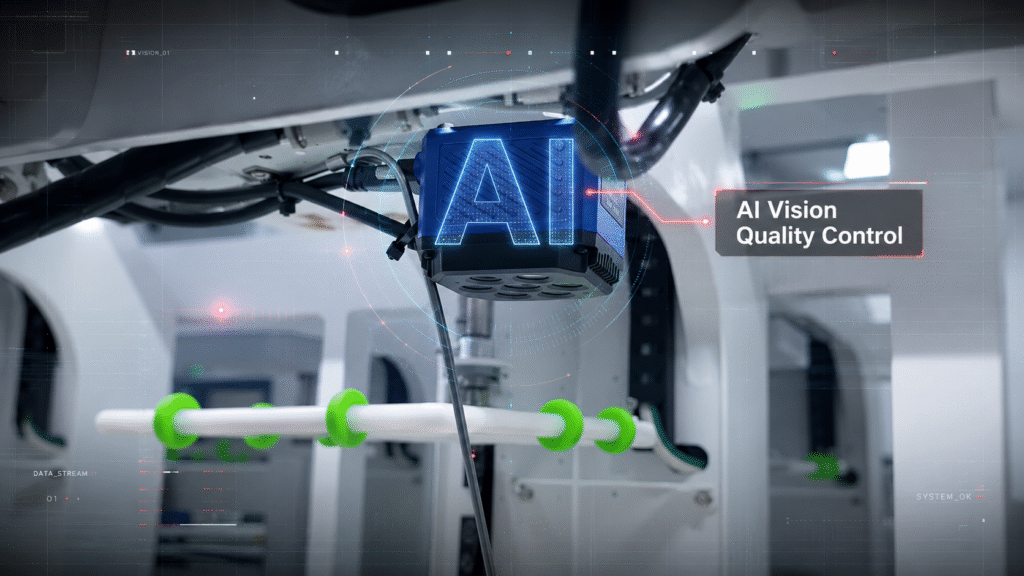
Heat transfer pressing of chest logos and neck labels seems like a simple operation, but it’s actually one of the most defect-prone steps in garment manufacturing — especially for major brand orders that demand absolute logo placement accuracy. This article directly compares traditional manual pressing against automatic pressing with AI camera inspection, helping factories make the right investment decision.
Manual Logo Pressing: Where Are the Weak Points?
In a manual heat transfer process, operators place the label/logo onto the fabric by hand, aligning it based on experience or a simple guide, then feed it into a heat press machine to finish. This process has 3 inherent weaknesses:
- Position misalignment from inconsistent manual handling — every operator has a different level of precision, and even the same operator struggles to maintain absolute accuracy across an 8-hour shift.
- Defects are only caught after completion — manual pressing has no automated check before pressing, so a misaligned logo only becomes visible after the garment is finished, wasting material and requiring costly rework.
- Speed is limited by manual handling pace — output is hard to scale beyond a certain threshold, even with overtime or additional labor.
Automatic Pressing with AI Inspection: The Difference Is a Dual Inspection Mechanism
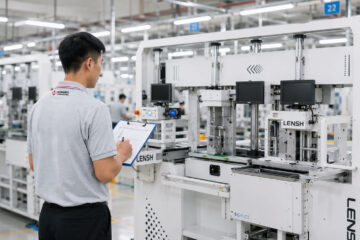
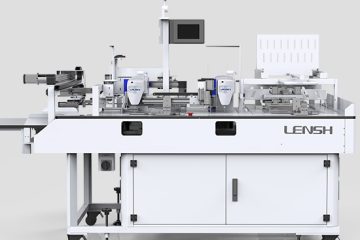
New-generation automatic heat transfer machines (such as 5-head AI-integrated models) directly address all three weaknesses above through AI camera inspection at two stages:
- Before pressing: the AI camera automatically detects the position and alignment of the label/logo on the fabric piece, catching misalignment at the input stage — before heat is even applied to the fabric.
- After pressing: the system re-scans the finished piece to confirm quality standards are met before moving to the collection stage, minimizing the chance of a defect reaching the final output.
Combined with a multi-head rotary pressing mechanism, processing speed increases substantially compared to manual pressing — based on real-world data from some current machine models, processing time can drop from roughly 23–28 seconds per piece (manual pressing) to around 7 seconds per piece.
Direct Comparison Table
| Criteria | Manual Pressing | Automatic AI Logo Pressing Machine |
|---|---|---|
| Logo position accuracy | Depends on operator skill, inconsistent | High, automatically checked before pressing |
| When defects are caught | After completion (late) | Before pressing (early, reduces waste) |
| Processing speed | Limited by manual handling pace | Significantly faster with multi-head automation |
| Operator skill requirement | High, needs experience with placement | Lower, machine handles positioning automatically |
| Investment cost | Low (basic heat press machine only) | Higher (integrates AI camera, multi-head mechanism) |
| Best suited for | Small-scale factories, orders without strict precision requirements | High-volume factories, brand orders with strict quality standards |
When Should a Factory Switch from Manual to Automatic AI Logo Pressing Machine?
- Major brand orders with strict logo-position inspection standards — even minor misalignment can result in a shipment being rejected during buyer QC inspection.
- Current defect rate at the logo pressing step is high, causing significant rework cost or written-off inventory.
- Volume at the logo pressing operation is large enough for the automation investment to pay back within a reasonable timeframe.
- The factory struggles to hire experienced operators for this specific operation.
Conversely, for small-scale factories with low logo-pressing volume and orders that don’t require strict precision, manual pressing with a basic heat press machine remains a cost-effective choice.
📖 This is another example of a Special Purpose Machine (SPM) dedicated to a single operation — learn more in: “What Is a Special Purpose Machine (SPM)? How It Differs From Standard Industrial Sewing Machines”
Frequently Asked Questions
With highly skilled operators and small order volumes, manual pressing can still achieve good accuracy. However, consistency across hundreds or thousands of pieces in a large batch is where manual pressing struggles to compete with an automated AI inspection system.
The AI camera system before pressing primarily detects misalignment in the position and orientation of the label/logo on the fabric piece relative to the pre-set standard position, preventing this defect before heat is applied to the fabric.
This should be evaluated based on the actual volume of the logo pressing operation and the buyer’s quality requirements. If volume is low and orders don’t demand strict precision, a small factory can continue using a basic heat press machine and consider automation investment as scale increases.
Contact us in Southeast Asia - South Asia:
- Singapore: 7 Temasek Boulevard, #43-01A Suntec Tower One, Singapore 038987.
- Vietnam - Philippines - Thailand - Cambodia: Unit 1, 3rd Floor, Building H, Street 17, Tan Thuan Export & Processing Zone, Tan Thuan Ward, HCMC, Vietnam.
- India: Sy. No. 23/8, Ground Floor, Masthappa Layout, Near Yashas Vidya Kendra School, Somashettyhalli, Chikkabanavara Post, Bangalore - 560090 , Karnataka, India.
- Bangladesh: Mizan House, 6th Floor, Flat 6/A, House 6, Road 2, Lane 1, Block G, Halishahar H/E, Chattogram, Bangladesh.
- Phone: (+84) 0983 309 910 (WhatsApp, WeChat, Zalo)
- Email: marketing@hoshima-int.com
- LinkedIn | Facebook | YouTube: Hoshima International